Introduction
Wire transfers between the UK and India happen on a scale of a million every month. It can be to support one's family, pay for services, or get paid for work. Sure, wire transfers are common. But between exchange rates, bank fees, and paperwork, the actual process behind it can get confusing fast.
Here, we break it all down. We dive into the nitty-gritty of what a wire transfer is, how it works, and how you can wire transfer money from the UK to India.
What is a wire transfer?
Wire transfer is a payment method that involves electronic transfer of money from one bank account to another. This can happen at the local or international level. Wire transfers are known for their speed. Usually, they enable the transfer of funds on the same day. But if it's an international transaction, the settlement timing can vary, typically around 1-3 business days.
The term “wire” actually has historical connotations, when banks would send payment instructions to each other over telegraph wires. The name stuck even as the technology evolved from telegraph wires to modern digital networks.
As opposed to other electronic methods of payment, wire transfers are processed individually, rather than in batches, and verified in real-time. They are also not revocable. That means, once a transfer has been initiated, it’s not easy to get it reversed, which gives it a sense of security and reliability. Especially when high-stakes transactions are concerned.
How a wire transfer from the United Kingdom to India works
Let’s say you want to transfer money from the UK to India. Here is how it will happen:
Step 1: You initiate the transfer
You go to your UK bank (say, Barclays or HSBC) and provide the recipient's details like their name, Indian bank account number, and the bank's SWIFT/BIC code. The SWIFT code is the bank's international address.
Step 2: Your bank verifies everything
The sending bank checks your account balance and confirms the transaction details before anything moves.
Step 3: The money travels through SWIFT
Well, not money exactly. Just the message that contains details about the money. It’s known as payment instructions.
This is the key part. With international payments, it’s not easy to directly transfer money as banks in different countries use systems that don't naturally connect. Wire transfers solve that problem using the SWIFT network, which links thousands of banks worldwide and ensures they can communicate in the same way.
So, in this step, a message is to be transferred to the recipient bank about how much money is to be transferred and to whose account.
Step 4: Intermediary banks may get involved
Your UK bank and the Indian bank may not have a direct relationship with each other. In that case, the payment instructions pass through one or more intermediary banks that do have those connections.
They work as relay stations. Each one passing the message along to the next until it finally reaches the destination. And at each step, it's still just ledger entries being updated, not cash being physically handed over.
Step 5: The Indian bank credits the account
Once the payment instructions finally arrive at the Indian bank, it credits the recipient's account with the transferred amount. Post that, both you and your Indian recipient will get a confirmation notification.
Step 6: Settlement between banks
The actual transfer of money occurs during the settlement, when banks settle funds among themselves through their central bank or clearing houses.
What are the different methods to send money from the UK to India?
Apart from the wire transfer, there are several other methods you can use to send money to India from the UK. These include:
- Online money transfer services: Payment providers like Xflow, Wise, or Remitly allow transfer of funds much cheaper and faster than traditional bank wire transfers. They often maintain local bank accounts in both countries. So when you send money from the UK, the service collects your GBP in the UK, and a local pool of INR is credited to the recipient in India.
- Foreign currency demand draft: A physical draft issued by your UK bank in INR or GBP, which is then deposited in an Indian bank. However, it’s very old school and slow, rarely used anymore.
- Cash pickup services: Western Union and similar services allow the recipient in India to walk into an agent location and collect cash. Quite useful if the recipient doesn't have a bank account.
- Cryptocurrency: Some people send crypto (like USDT or Bitcoin) from the UK, and the recipient converts it to INR in India. They are no doubt fast and borderless, but also volatile, as regulatory rules around crypto in India are still evolving, so it carries some risk.
What are the required details for an international wire transfer?
To make sure the money you wire reaches your recipient in India, it’s important to provide all the necessary details to your bank account, such as:
- The recipient’s name and address
- Their bank’s name and branch address
- SWIFT/BIC code
- Currency and amount to be sent
- The exact purpose of the transfer
SWIFT/BIC codes and their role
SWIFT code, sometimes also referred to as the Bank Identifier Code (BIC), is used to differentiate one bank branch from another. Because they are unique for a particular bank, they come in handy for identification during the transfer of funds.
Whenever money is wired between bank accounts, the SWIFT/BIC code is a necessary requirement to locate the specific recipient’s bank branch.
The code is usually of 8 or 11 characters, with the first 4 characters indicating the bank code, the next 2 signalling the country code, the following two indicating the location code, and the last 3 indicating the branch code.
What are the transfer fees and charges?
When you initiate a wire transfer from the UK to India, you’ll be charged a combination of following transfer fees:
1. Sending fee: Your UK bank charges a flat fee just to initiate the transfer. This typically ranges from $25 to $50 for online wire transfers, and can be even higher if you walk into a branch to do it.
2. Intermediary bank fees: Remember those relay stations we talked about? They don't work for free. Each intermediary bank that handles your transfer deducts its own processing fee, usually around $15 to $30 per bank. If your transfer passes through two intermediary banks, that's two deductions before it even reaches India.
3. Foreign exchange markup This is the big one, and the one most people don't notice. When your GBP gets converted to INR, your bank doesn't give you the real exchange rate (the one you'd see on Google). They apply a markup of 1% to 4%, depending on the currency pair and transaction amount. On a large transfer, this invisible fee can actually exceed all the other charges combined.
4. Beneficiary bank fees: The Indian bank receiving the money may also charge a fee on its end. This can range from nothing for premium account holders to around ₹1,000 for standard accounts. Since the transfer is for India, banks also charge a fee to issue an FIRC, a document required for regulatory purposes.
Exchange rates and forex margins
When you wire transfer money from the UK to India, your GBP has to be converted to INR at some point in the journey.
There are two aspects of exchange rates you need to know about. The first is the mid-market rate, which is the real, fair exchange rate that you'd see if you searched "GBP to INR" on Google. The second is the rate your bank actually offers you, which is always a little (or a lot) worse than the mid-market rate.
The difference between the two is called the forex margin or forex markup. Your bank pockets this difference as profit. They might not advertise it as a fee. Which is why most people never even notice it.
Let’s understand this with a simple example. Assume that the mid-market rate is ₹107 for every £1. Your bank might offer you ₹103 instead. That's a ₹4 difference per pound. On a £5,000 transfer, that's ₹20,000, roughly £190, lost purely to the exchange rate, before any flat fees are even counted.
How much time do wire transfers take?
The actual time is hard to put down as the time varies, depending on the type of transfer.
Domestic wire transfers are actually pretty fast, same day or next business day. The only catch is timing. If you send it after the bank's cutoff, it doesn't go out until the next business day. Send it on a Friday afternoon, and you're waiting till Monday.
International wire transfers are where things slow down to that 1-5 business days range. The money often passes through multiple intermediary banks, each doing its own processing and compliance checks. Add in currency conversion, different time zones, and different countries' banking hours, and every single leg of that journey adds time.
RBI regulations for receiving foreign funds
Inward remittances in India are regulated by the RBI, which is powered by the Foreign Exchange Management Act (FEMA) guidelines, according to which:
- Foreign inward remittances should be received via an Authorized Dealer Category-I bank.
- It’s necessary to keep records of foreign transactions like FIRA, invoices, bank advice, contracts for at least five years.
- The transaction needs to be accompanied by a relevant purpose code that clarifies the reason for the transaction.
- AD banks must ensure that KYC and other critical verifications of the involved parties are thoroughly done.
- As an exporter, you must follow up with your foreign buyers within 9 months for goods and 6 months for services.
- You need to submit forms like SOFTEX and EDF so that RBI can monitor foreign currency inflow.
Tax implications in India
Whether or not taxes will be applied depends on why the transaction is being done.
1. The nature of the money: Capital receipts, like savings transfers or loan proceeds, are tax-free. Revenue receipts like salary, business income, or interest are taxable.
2. Who's sending it: Gifts from defined relatives like spouse, siblings, parents, or children are fully exempt regardless of the amount. Gifts from non-relatives are only exempt up to ₹50,000 per year in total.
3. Your residential status: Foreign income received by someone who is a resident Indian is taxed at the same rates as domestic income. No special treatment either way.
4. Whether it's a business or personal transfer: Family maintenance sent to parents or a spouse is not taxable. It's treated as support, not income. But interest earned on an NRO account is taxable, even though the principal transfer itself isn't.
5. GST angle for service exporters: If you're a freelancer exporting services, it's treated as zero-rated under GST. Meaning no GST is payable, as long as you meet the conditions and ideally file a Letter of Undertaking (LUT).
For freelancers, Section 44ADA is a big relief. You only need to declare 50% of your gross receipts as taxable income, as long as your total earnings stay under ₹75 lakhs and cash receipts don't go beyond 5% of that.
Limits on international transfers
India doesn't actually impose a strict cap on inward remittances. There are some practical limits, though, depending on the purpose and the method of payment you use.
- For personal/family transfers: If the money is being sent for family support or helping out foreign tourists in India, the maximum amount is $2,500 USD per transfer. And a single recipient can receive a maximum of 30 such remittances in a year.
- For business/trade payments: In case you're receiving payments through online payment gateways for import/export-related transactions, the limit is $10,000 USD per transaction. Larger B2B payments just get split into multiple $10,000 chunks until the full amount comes through.
Common issues and delays
Even though everything might look fine on paper, the money can still get held up or flagged, and here are some reasons why that usually happens:
- Wrong or missing documentation, like FIRC, purpose codes, or source of funds proof.
- Multiple intermediary banks in a SWIFT transfer. Each adding their own processing time.
- Outdated KYC details with your bank leading to compliance holds.
- Large or unusual transfers that might get flagged for anti-money laundering checks.
- Incorrect IFSC code or account number leading to failed or returned transfers.
- Transfers that were initiated on weekends or Indian public holidays have to wait till the next working day.
How to track a wire transfer?
When you send a wire transfer money from the UK to India, you can track that transfer in the following ways:
1. Using reference number: When you send a wire, your provider gives you a tracking or reference number. This might be called a UETR, a transaction ID, or a reference number, depending on the platform. You can use it for tracking.
2. Using your bank details: Log into your bank's online portal or app and look for the transaction in your international payments history. You can also call your bank directly with the reference number, and they'll tell you its status.
Safety and security tips
Compliance checks and intermediary bank delays are mostly out of your control, but there are some steps you can take to make the wire transfer as smooth as possible:
- Always double-check the recipient's account number, IFSC code, and SWIFT/BIC details before confirming. A single wrong digit can send money to the wrong account.
- Only use RBI-authorized banks or regulated money transfer platforms registered with HMRC in the UK.
- Never share your transaction reference number, OTP, or other login details with anyone, even if they claim to be from your bank.
- Compare exchange rates and fees on a trusted aggregator before committing to a payment provider.
- If you’re using an online payment provider, make sure it uses end-to-end encryption and two-factor authentication (2FA).
- Use your own secured internet connection. Never initiate a transfer over public Wi-Fi.
Conclusion
Wire transfers between the UK and India are pretty straightforward, save for the layers of fees, documentation, and wait times. That can be frustrating, no doubt, especially if you're a business receiving payments regularly. Knowing the process can help, but having the right infrastructure can make it a whole lot smoother. An infrastructure that Xflow can provide you.
Xflow is built for Indian businesses receiving money from abroad. It offers same or next business day settlements, support for 25+ currencies, free eFIRA, and fully transparent pricing, so you always know the FX rate and charges upfront, with no surprises. Its receiving accounts give Indian businesses local collection details in the currencies they are paid in, removing an extra conversion step on funds coming in from the UK.
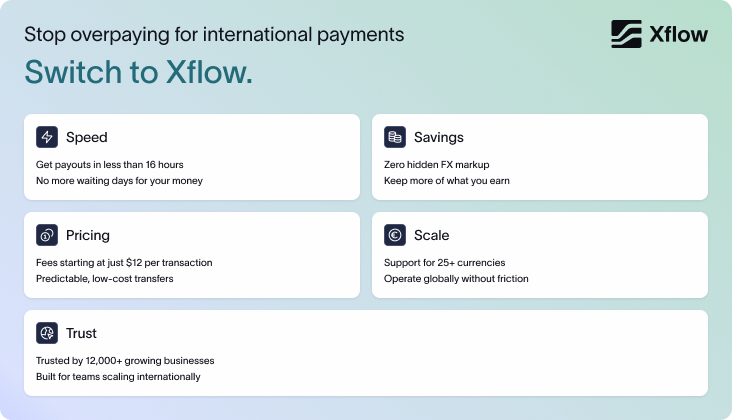
Compared to conventional banking channels, businesses save up to 50% on transfer fees. And unlike traditional banks, there are no transaction limits. You can bring in money from anywhere in the world in a fully compliant way.
If your business regularly receives international payments, it's worth making the switch. Visit its website now to get started.
Frequently asked questions
You can easily wire transfer money from the UK to India by providing your recipient's bank details to your UK bank, and they'll send it through the SWIFT network.
Typically 1-5 business days, depending on how many intermediary banks are involved in the transfer.
You'll need details like the recipient's name, bank account number, the amount getting transferred, its purpose, IFSC code, and the bank's SWIFT/BIC code.
A SWIFT code is basically your bank's international address. It ensures the money reaches the right bank.
The actual varies a lot. It usually depends on the sending fee, intermediary bank charges, and a forex markup. Some banks also charge additional fees for issuing compliance certificates like eFIRA.
Banks don't offer the real mid-market rate that you see on the news or Google. They add a markup of around 1-4% on top of the mid-market rate, so you receive less than what you’re supposed to.
No, you don't need RBI approval to receive money. But the transfer must come through an authorized dealer bank and be accompanied by the correct purpose code.
India doesn't cap inward remittances. But for personal/family transfers, the limit is $2,500 per transfer, with a maximum of 30 transfers per recipient per year.
Yes. Your provider gives you a reference number or UETR when you send money. You can use it on your bank's portal or app to check the status anytime.
Contact your bank with your reference number right away. Delays usually happen due to compliance checks, wrong details, or intermediary bank holdups. Your bank can investigate.
Yes, wire transfers are one of the most secure ways to send money internationally. Just make sure you're using a regulated provider and always double-check the recipient's details before confirming.
It depends on why the money is being sent. Business income is taxable, gifts from relatives are not, and gifts from non-relatives are only tax-free up to ₹50,000 annually.
Platforms like Xflow, Wise, or Remitly are often faster and cheaper than traditional banks. They're a great option, especially if you're receiving business payments regularly from abroad.
Wire transfer is the overall process of moving money between banks electronically. SWIFT is the messaging network that makes international wire transfers possible by letting banks communicate securely with each other.
Online payment platforms, cash pickup services, and fintech providers are all solid alternatives. For businesses receiving payments from abroad, platforms like Xflow offer faster settlements, better rates, and compliance built in.