Introduction
Compliance, reporting, and paperwork are common hurdles for any international business. If your business is receiving payments from abroad, you might be familiar with documents called FIRC and FIRA. They act as “proof” of money received.
Here, we’ll discuss both documents, their differences, when you might need them, and how to actually obtain them, so that your business stays fully compliant with national regulations. We’ll also touch on the common mistakes businesses make, so you can stay prepared.
Key Takeaways
- FIRC and FIRA help Indian exporters and businesses prove foreign inward remittances, stay FEMA-compliant, and claim GST refunds and export incentives.
- FIRC was the legacy physical document; FIRA has been the digital standard since 2016 (post-EDPMS launch).
- FIRC is still required for FDI/FII cases; FIRA is used for regular export payments.
- Both are issued only by AD Category I banks authorised by RBI.
- Platforms like Xflow auto-generate e-FIRA within 24 hours of withdrawal.
In this guide, you'll learn exactly what FIRC and FIRA mean, how they differ, when each is required, and the step-by-step process to obtain them. You'll also discover the compliance risks of missing documentation, common mistakes to avoid, and how modern payment platforms simplify e-FIRA generation for exporters.
What is FIRC (Foreign Inward Remittance Certificate)?
FIRC, also known as a “Foreign Inward Remittance Certificate”, is a bank-issued document for inward remittances. In other words, an FIRC is proof for payments received in a foreign currency.
This proof in the form of an FIRC is required by the exporters and sellers of all goods and services that conduct their trade internationally. They help you stay compliant with export rules and access export-related incentives.
FIRCs can be issued by AD (Authorised Dealer) Category I banks in India, according to the RBI and FEDAI. They typically contain information about the buyer and seller, addresses, exchange rates, amount and purpose of remittance.
Since 2016, physical FIRCs have been discontinued (except for foreign direct investments and foreign institutional investments), and electronic documents have been issued in their place.
Once issued, this certificate reflects a remittance that has already landed in the beneficiary bank's vostro account. To see that side of the process, read how FIRC works with vostro payments.
What is FIRA (Foreign Inward Remittance Advice)?
FIRA is a “Foreign Inward Remittance Advice”, commonly received as a digital document or slip. Since the launch of the Export Data Processing and Monitoring System (or the EDPMS) in 2016, FIRA has been issued as the standard proof of foreign payment.
Many of its characteristics are similar to the FIRC. It contains information about the seller and buyer, exchange rate, purpose code, and amount. However, compared to the archaic FIRC, FIRA is easier to obtain and access.
Let’s take a closer look at the differences between the two in the next section.
What are the key differences between FIRC and FIRA?
While both the FIRC and the FIRA have roles in legitimising payments received internationally, there are a few key differences:
- FIRC in its traditional role has been phased out. FIRA is the standard document for foreign payments accepted today.
- FIRC requires an application process, while FIRA is issued automatically.
- FIRC is still provided in a physical format. FIRA is entirely digital.
In the next section, we will look at a direct comparison of the two documents.
If you also deal with a Bank Realisation Certificate, the BRC vs FIRC comparison sets out how those two differ.
How do FIRC and FIRA compare side by side?
To make the differences clearer, here’s a quick side-by-side comparison of FIRC and FIRA:
| Aspect | FIRC | FIRA |
|---|---|---|
| Full form | Foreign inward remittance certificate | Foreign inward remittance advice |
| Format | Sometimes physical, now electronic | Electronic |
| Usage | Limited , for special cases (FDI, FII) | Common for most inward remittances |
| Issuance | On request | Usually automatic |
| Relevance today | Reduced | Standard |
Or: FIRC was the traditional proof of inward remittance, but FIRA has become the standard in most cases today.
When do you need FIRC vs FIRA?
In most cases today, you’ll need FIRA instead of FIRC. If you are a business owner, the document you’ll typically use is a FIRA (or eFIRA). It serves as standard proof of inward remittance.
FIRC, on the other hand, is usually required only in specific cases like foreign direct investment (FDI) or foreign institutional investment (FII).
For both scenarios, FIRC and FIRA will be needed for income tax filing, demonstrating your regulatory compliance, maintaining your own records, and claiming benefits (like incentives and refunds).
These requirements are built around traditional bank-mediated transfers. For a look at how proof-of-payment expectations differ on a newer rail, see our ach vs stablecoin comparison.
How can you obtain a FIRC?
To obtain a physical FIRC, you will need to follow these steps:
- First, when receiving a payment, make sure the sender uses the right purpose code.
- Wait for the payment to be credited. You'll only be able to request FIRC after the money has been credited to your account.
- Request FIRC from your bank. Fill out the application form and provide all the necessary details and documents. They might include bank statements, transaction invoices or request letters.
- Pay the issuance fee, if applicable to you.
- Download or collect your FIRC. A physical copy can be collected from your bank branch. AN e-FIRC can be downloaded from the bank’s portal, or received on your email.
Some banks want the request in a set format, and our FIRC request letter guide shows what to include.
How can you obtain a FIRA?
The process of obtaining FIRA is a lot easier. Once the international payment has been credited to your account, your bank will automatically generate FIRA, by picking up the transaction details. In rare cases, you may have to fill out an application.
The document will be easily downloadable on the internet banking platform.
Certain payment platforms like PayPal and Xflow can auto-generate FIRAs for all your transactions.
Why are FIRC and FIRA important for compliance?
Here, we’ll see why your business needs to carefully account for FIRC and FIRA documents. They have the following importance:
1. Compliance
According to RBI and FEMA regulations, all foreign payments into India need to be tracked. Having FIRC and FIRA for your inward remittances will help you stay compliant and avoid regulatory issues.
2. Tax benefits
With FIRC and FIRA, you can get access to GST refunds and other export-related benefits.
3. Financial tracking
These documents are invaluable for accounting. FIRC and FIRA will help you keep a clear record of payments, along with fees and exchange rates for each of them.
4. Business credibility
These documents serve as proof of foreign income, which can be requested by banks and lenders.
5. Audit prep
Lastly, having both of these documents ensures you are always prepared for audits and reviews.
For how these documents sit against the export-linked certificate, see BRC vs FIRA.
What are common mistakes businesses make with FIRC and FIRA?
When dealing with multiple payments and certificates, it’s easy to get lost. Here are some common mistakes that you can avoid in your processes:
1. Confusing FIRC and FIRA
Because of recent changes in regulations, the two terms are often used interchangeably. However, keep in mind the core difference between FIRC and FIRA, and use the right document where necessary.
2. Incorrect details
Errors in information like amount, purpose code, or sender details can create issues during verification. Double-check all the information to make sure you get the right documents for your needs.
3. Delayed requests
Waiting too long to request FIRC can lead to other downstream delays. It’s recommended to apply as soon as possible.
4. Lack of organisation
Another common mistake is not storing your FIRC and FIRA properly. Keeping everything accessible and in one place will be useful for compliance, income tax filing, getting access to export incentives, etc.
Conclusion
With the right documentation, it’s easy to manage your cross-border business. But with the right tools, it gets even easier.
As cross-border rails keep evolving, comparisons like cbdc vs stablecoin are worth following to see how documentation and compliance expectations might shift next.
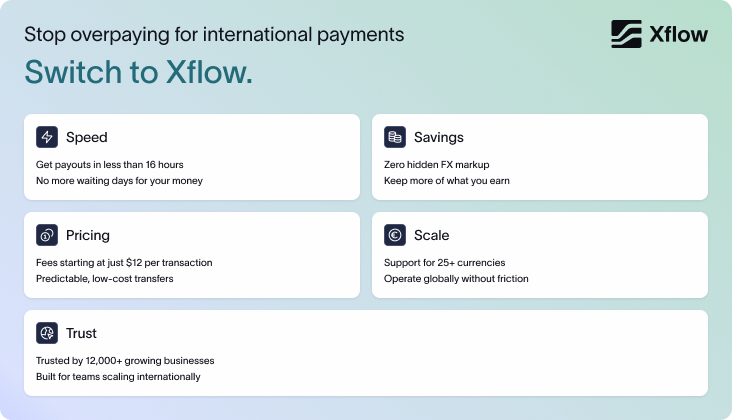
Payment platforms like Xflow are preferred today for their efficiency and accessibility. Xflow offers:
- Mid-market rates, letting you save on FX costs
- Quick fund settlement within 1 business day
- Auto-handled e-FIRA, available within 24 hours of payment withdrawal
- Large payments available on a single invoice
- ISO 27001 and SOC2 certifications for maximum security
- API integrations with all major fintech platforms
These features, provided with Xflow’s comprehensive onboarding and user support, make Xflow the preferred partner for global transactions.
Much of this comes down to how Xflow’s receiving accounts are structured: each inward payment is credited with an automated eFIRA attached, so the FIRC-vs-FIRA question mostly resolves itself.
One account. Multiple currencies. Endless possibilities. Start with Xflow today!
Frequently asked questions
FIRC’s use case is restricted to transactions like FDI and FII. FIRA is the modern, digitally issued document that serves as proof of international payments.
FIRA is considered a valid replacement and serves as a modern proof of inward remittance in India, since 2016.
Both the FIRC and the FIRA are issued by RBI-authorised AD Category I banks and financial institutions.
Yes. Today’s electronic FIRC or FIRA is required for the export of both goods and services by Indian businesses, for compliance, benefits, and GST refunds.
Except in cases of FDI and FII, yes, freelancers can use the electronically-issued FIRA instead of the legacy physical FIRC, which was discontinued in 2016.
FIRA is required to claim GST refunds for your business, in addition to other requested documents. It’s important to get this documentation in one place to simplify the refund application process.
A FIRA will contain details about the international transaction, such as the names and addresses of the sender and receiver. It will also include the transaction amount and purpose code.
Physical FIRCs can take days or weeks to be issued. Digital formats, such as FIRAs, are issued much more quickly.
An e-FIRC is issued in specific cases, such as the export of goods, software, etc. A FIRA is a general-purpose document serving as proof of inward remittance in India.
An e-FIRC is issued in specific cases, such as the export of goods, software, etc. A FIRA is a general-purpose document serving as proof of inward remittance in India.
In the absence of a valid FIRC, your GST refund claims can be denied, and export incentives like the RoDTEP can be missed. You also risk FEMA non-compliance, and the auditing process can become more challenging.