Introduction
Moving money today isn’t what it used to be. Alongside traditional methods like wire transfers, newer options like stablecoins are changing how quickly and how easily you can send funds across borders.
To put that shift into perspective, stablecoins now account for trillions of dollars in transaction volume annually, showing just how quickly they’ve moved from a niche crypto tool to a mainstream payment option.
On one hand, wire transfers have been the go-to for decades. There is already wide acceptance, regulation, and support from trusted banking networks, such as SWIFT. However, stablecoins such as Tether (USDT) and USD Coin (USDC) provide a faster way to transfer funds using blockchain technology.
Thus, when making payments, whether business or personal, the question arises: “Which of the two methods is more effective?”
In this guide, you'll learn what stablecoins and wire transfers are, and how they compare across speed, cost, transparency, security, and regulatory frameworks. You'll also discover the pros and cons of each for cross-border payments, key risk factors, real-world use cases for businesses and individuals, and how both rails integrate with financial systems.
Key Takeaways
- Understanding stablecoin vs wire transfer trade-offs helps Indian businesses and freelancers choose the right payment rail for each transaction - balancing speed, cost, regulatory comfort, and reliability.
- Stablecoins (USDT, USDC) settle in seconds-to-minutes with low fees but require crypto wallets and varying regulatory acceptance.
- Wire transfers (via SWIFT, CHIPS, FedWire) settle in 1-5 business days with multiple fees but offer global acceptance and bank-mediated security.
- For Indian businesses, stablecoins face 30% VDA tax + 1% TDS at conversion to INR, often eroding the speed/cost advantages over regulated wire transfer alternatives.
- The pragmatic answer is rarely either/or - many businesses use stablecoins for fast operational payments and wire transfers (or platforms like Xflow) for compliance-heavy, FEMA-aligned settlement.
What is a stablecoin?
A stablecoin is a cryptocurrency that’s built to keep its value stable, usually by being tied to the US dollar. Some examples include USDT (Tether) or USD Coin (USDC). We compare the two in our USDT vs USDC guide.
Why does that matter? Because when you’re sending or holding money, you don’t want the value changing halfway through.
Stablecoins solve that while still giving you the benefits of blockchain. You can send money directly to someone, anywhere in the world, without waiting for banks to process it. It’s quick, straightforward, and doesn’t depend on traditional systems.
If you are curious how new coins actually enter circulation, our guide to stablecoin minting walks through the process.
What is a wire transfer?
A wire transfer is a means of transferring funds directly between two bank accounts. This method is frequently used, particularly when substantial sums or foreign transactions are involved.
How does it work for you? Your bank will send the funds to the recipient's bank, usually via SWIFT. If it's an international transaction, it may be relayed through several intermediary banks before arriving at the destination account.
Since banks play a role at each stage, it is safe and widely accepted. However, there are also drawbacks to this method since it usually takes one to several days to process the transaction and incur various costs.
What are the key differences between stablecoins and wire transfers?
Both stablecoins and bank wires are useful for transferring funds, yet the difference in how the transfer takes place makes your experience quite different from one another.
With stablecoins, you’re sending money directly to another person using a blockchain network. There’s no bank in between, so the process is faster and usually more flexible. The wire transfer is conducted by your bank itself using networks such as SWIFT, and in the process, there are many banks that can be involved.
Here’s how stablecoin vs wire transfer will affect you:
Control
You have full control over your stablecoins. On the other hand, you require the help of banks when performing a wire transfer.
Speed
Stablecoin payments can be settled within minutes; however, it might take longer for the wire transfer to process.
Cost
Stablecoin transactions tend to be more affordable compared to a wire transfer, which may incur sending, receiving, and conversion fees.
Access
Stablecoin transactions require an internet connection and a wallet. Wire transfers require bank accounts on both ends.
Acceptance
Wire transfers are widely accepted globally. They are developing rapidly, but are not universally available.
Check out the stablecoin vs wire transfer comparison below for easy reference:
| Feature | Stablecoins | Wire transfers |
|---|---|---|
| How it works | Peer-to-peer on blockchain | Bank-to-bank via financial networks |
| Intermediaries | Usually none | Multiple banks/intermediaries |
| Speed | Seconds to minutes | Few hours to 2–5 business days |
| Transaction costs | Generally low, network-based | Higher, includes multiple fees |
| Accessibility | Requires internet + crypto wallet | Requires bank accounts |
| Transparency | Public blockchain records | Private, bank-controlled |
| Control | User-controlled funds | Bank-controlled process |
| Global acceptance | Growing, but limited in some regions | Widely accepted worldwide |
How do transaction speeds compare between stablecoins and wire transfers?
The process of sending funds via a stablecoin usually takes just several seconds to minutes to complete. As soon as you press the button, the transaction is immediately processed by the system and is confirmed without waiting for any office hours or approval from your bank.
As for wire transfers, the process is even more prolonged because banks are involved at every step. Transactions within a domestic financial network may take just several hours, while international ones may take 1 to 5 business days because they must pass through networks such as SWIFT, which takes a long time.
Here is one simple formula for you to consider:
- If you require immediate processing of your transaction, stablecoins become the fastest choice.
- If you can wait a couple of days, you still can rely on regular banking options such as a wire transfer.
What are the transaction costs and fees?
Stablecoin transactions are typically cheap, and the fees depend on the blockchain network used for the transfer. The only fee you will have to pay is a modest one, commonly referred to as a "gas fee." In some cases, even when there is an increase in transaction fees because of congestion within the blockchain, these will remain cheaper than regular bank fees.
A wire transfer, however, involves multiple fees, which may include the following:
- A sending fee from your bank
- A receiving fee on the other end
- Banks' intermediary fee costs
- Foreign currency conversion fees
The expenses may soon pile up, which might make the wire transfer process quite costly, particularly for transactions between countries.
And so, when trying to cut costs, stablecoins usually come out on top. But if you’re already operating within the banking system and need a regulated, widely accepted method, wire transfers may still be worth the extra cost.
Which is more transparent and traceable: Stablecoin or wire transfer?
In the case of stablecoins, all transactions will be recorded on the blockchain. This means that anyone, including yourself, can view any transaction by tracking its wallet address, to know when the transaction took place, if the recipient received it, and how much money was transferred.
Wire transfers are much more private. Once you initiate a transfer, the details are only visible to the banks involved. If you want to check the status, you usually have to rely on your bank’s updates or tracking through systems like SWIFT.
Put simply,
- Stablecoins give you more visibility and independent tracking.
- Wire transfers offer privacy but less direct insight into the process.
What are the security considerations?
As far as safety goes, stablecoins and wire transfers are both reliable, but for totally different reasons. It depends on who’s responsible and how problems are solved.
In the case of stablecoins, safety is guaranteed by cryptographic algorithms that operate within the blockchain system. It’s very difficult to tamper with transactions, and once they have been verified, it’s impossible to reverse them. The difference for you is that you have full control of your assets. You will lose them if you mismanage your wallet and transfer funds to an incorrect address.
Wire transfers follow a more traditional path. The banks take care of authentication, fraud, and transaction handling, often through channels like SWIFT. This provides an extra level of security, and sometimes, the bank can assist in case something is amiss – particularly if detected early enough.
Thus, the deal is fairly obvious:
- With stablecoins, you have more control and more accountability.
- Wire transfers offer institutional safeguards, but less direct control.
The safer option really depends on what you’re more comfortable with: managing things yourself or relying on a bank to handle it for you.
What are the regulatory and compliance requirements?
There is a legal framework for wire transfers, which includes the Uniform Commercial Code, the Electronic Fund Transfer Act, and other consumer protection laws. Also, banks are required to comply with other regulatory structures, such as KYC and AML. Every transaction must go through the scrutiny process and the banking system, and may be transmitted using communication networks like the SWIFT system. It is this structure which makes the wire transfer system standardized and recognized worldwide.
Regulation for stablecoins, however, is something that is changing as well. There are those that operate as a genuinely compliant stablecoin, and there are those that exist in countries with less strict regulations regarding financial services.
So from your perspective:
- Wire transfers feel more structured and universally regulated.
- Stablecoins offer flexibility, but the compliance landscape can differ by region and provider.
In short, one is built on decades of banking regulation, while the other is still finding its global rulebook.
What are the risk factors: Fraud, counterparty, and settlement risk?
When you move money, risk shows up in different forms depending on the system you use.
When it comes to stablecoins, there is always the risk associated with control and ownership. The fact that you are responsible for your own digital wallet means that your ability to keep it safe is crucial, as losing your credentials means you cannot recover them. There’s also counterparty risk, which depends on the issuer maintaining full reserves and operating transparently. If that trust breaks, the stability of the coin can be affected.
On the fraud side, scams often happen through phishing links or fake wallet addresses. Once a transaction is sent, it can’t be reversed. That leads to another important point: settlement risk is low in timing but high in finality. Payments settle quickly, but they’re final.
Wire transfers work differently. Here, banks act as intermediaries and follow strict verification processes, which reduces the chance of direct fraud. However, risks still exist—especially payment fraud or unauthorized transfers, where funds are sent to the wrong account or through social engineering scams.
There’s also settlement risk in timing and reversibility. Even when banks conduct investigations on suspicious transactions, once an international wire transfer has been made through systems like SWIFT, it becomes very hard to reverse the transaction.
Therefore:
- Stablecoins shift risk to the user and technology layer.
- Wire transfers shift risk to the banking system and verification process.
Both are secure in their own design, but the type of risk you take changes depending on which one you choose.
What are the use cases for businesses and individuals?
With stablecoins, the use cases are growing quickly in the digital economy. When you are a freelancer who deals with overseas clients, you can use stablecoins to be able to receive money faster and avoid the delay of a few days when using bank transfers.
They have also been employed by companies in carrying out cross-border transactions that require speed and lower fees. Stablecoins have also become popular within cryptocurrency exchanges and DeFi, where there is a need for speedy transactions. Stablecoins such as USDT and USDC have been popular choices for these kinds of transactions.
As for wire transfers, they remain the preferred mode for formal transactions or those involving large amounts of money. For instance, purchasing real estate, paying for corporate services, or even making payments for major business ventures overseas. This is because banks process these transactions using systems such as SWIFT.
From your perspective:
- For fast, flexible, and worldwide transactions for day-to-day or online-based payment processing, stablecoins are appropriate.
- For structured, compliant, and universally accepted payments for official purposes, traditional wire transfers remain the norm.
In many real-world cases, businesses actually use both stablecoins for faster operational payments and wire transfers for larger, regulated financial commitments. If your comparison is with US bank rails rather than wires, see our ACH vs stablecoin guide
How do stablecoins and wire transfers integrate with financial systems?
Integration through wire transfers exists within the international monetary system. It occurs daily with businesses, banks, and even governments making use of them. A lot of these transactions are facilitated by existing networks such as SWIFT, which links financial institutions worldwide. So if you’re already in the banking system, wire transfers feel like the default; they’re widely accepted, regulated, and deeply embedded in business operations.
Stablecoins are relatively new, but they are beginning to join that process in their own right. Cryptocurrencies such as USDT and USDC are becoming more popular via fintech apps, payment processors, and cryptocurrency exchanges that allow them to bridge the blockchain space and banks. Some tokens even span several networks; see how a cross chain stablecoin works.
Here’s how that plays out in real life:
- Businesses receive stablecoins and convert them into fiat for bank settlement.
- Payment platforms allow users to move between crypto wallets and bank accounts.
- Fintech APIs connect blockchain transactions with traditional accounting systems.
- Companies use stablecoins for fast movement and banking rails for final settlement.
So:
- If you’re operating fully within traditional finance, wire transfers already fit smoothly into your workflow.
- If you’re working across digital platforms or global teams, stablecoins give you a faster layer that can still connect back to banks when needed.
In many real-world setups, both systems work together quietly in the background: stablecoins for speed and movement, and banking systems for settlement, compliance, and reporting.
What are the future trends for digital assets vs traditional banking?
Traditional banking isn’t standing still. Systems such as SWIFT are already taking steps towards making cross-border payments more efficient and almost instant. This has involved improvements in infrastructure by banks so as to decrease costs, delays, and increase transparency.
For a closer look at how the two rails compare directly, see our stablecoin vs swift comparison.
Meanwhile, digital assets, particularly stablecoins such as Tether and USD Coin, are setting new standards. Immediate transfer, 24/7 availability, and programmatic payment are no longer "optional"; rather, they have become the bare minimum. Increasingly these run across several networks at once, as our multi chain stablecoin guide explains.
This is what you can expect:
- Faster traditional systems: Wire transfers becoming quicker, with shorter settlement times.
- Clearer regulations: Governments building defined rules around stablecoins and digital assets.
- Named legislation: In the US, the GENIUS Act is already setting the framework other markets are watching closely.
- Hybrid payment models: Businesses using both stablecoins and banking rails, depending on the use case.
- User experience: You will not necessarily be able to tell if your payments are processed using a bank or blockchain technology.
- Digital currency adoption: Governments issuing their own digital currencies along with stablecoins.
In the future:
- You can expect payments to be instant, regardless of the system.
- You will have more options, but less need to think about how the money actually moves.
The future isn’t about stablecoins replacing wire transfers. It’s about both evolving until the gap between them becomes much smaller, and for you, moving money just feels faster, simpler, and more predictable.
Conclusion
At the end of the day, it’s not about picking a winner; it’s about picking what works for you in the moment.
Stablecoins provide you with speed, adaptability, and a quicker channel for transferring funds, particularly when operating globally and digitally. Wire transfers, on the other hand, deliver structure, worldwide compatibility, and security due to well-established financial infrastructures such as SWIFT.
What’s becoming clear is that both aren’t competing as much as they’re complementing each other. In real-world use, you’ll often find businesses and individuals using stablecoins for faster movement and traditional banking for settlement, compliance, and larger transactions.
And as financial systems continue to evolve, the gap between the two is only going to get smaller.
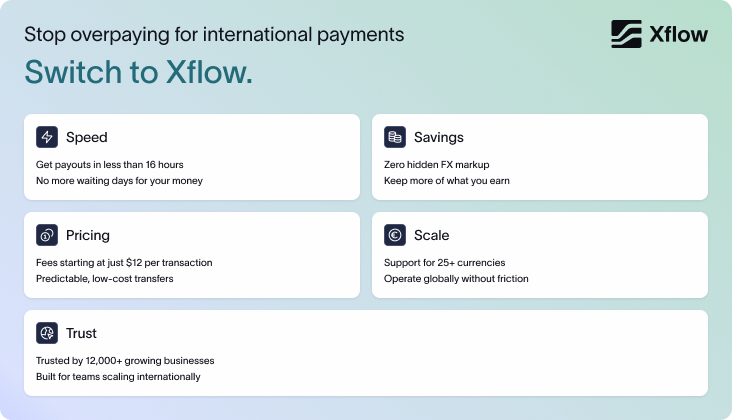
If you’re looking to simplify how you receive money globally, having access to both options makes a real difference. With Xflow, you can move between digital and traditional payment rails seamlessly, so you’re not stuck choosing one but choosing what works best each time. Its receiving accounts are built to receive funds via multiple rails, including stablecoins, into one place.
Faster payments. Smarter transfers. Total control.
Frequently asked questions
A stablecoin is a cryptocurrency operating on a blockchain technology platform that enables payment transfers to anyone instantly. On the other hand, a wire transfer requires banks to transfer funds, and these use platforms such as SWIFT to accomplish this.
Stablecoins are usually much faster. Transactions are settled within minutes, whereas wire transfers may require several hours or days, depending on the payment transaction.
Transferring using stablecoins has low costs since there are no processing fees. Wire transfers may involve multiple charges, including sending, receiving, intermediary, and conversion fees.
Stablecoins allow real-time tracking since transactions occur via the internet, while wire transfer transactions are confidential and are known by banks alone.
For sure, particularly for fast and inexpensive transfers. But they haven’t fully replaced wire transfers, mainly because banks are still required for compliance-heavy and widely accepted transactions.
While stablecoins depend on your wallet security, the chances of recovering the lost funds are very low if you lose access or make a mistake while transferring money. In comparison, wire transfers depend on banks, which have their own security measures but can also be prone to hacking and other issues.
Wire transfer transactions follow international rules and have compliance mechanisms built into the process, making them more regulated compared to stablecoins, whose regulations are yet to be developed.
This entirely depends on your requirements. While stablecoins are ideal for instant payments and transactions, wire transfers work well for formal transactions.
Indirectly, yes. There are many fintech systems that can connect blockchain technology to conventional banking, enabling money transfers between both.
Stablecoins have certain restrictions, such as regulatory issues, regional availability, and infrastructure problems, while wire transfers have no major restrictions.
No. Stablecoins are increasingly accepted across the globe, although their acceptance rates are not yet universal like wire transfers.
Blockchain-based stablecoin transactions are settled almost immediately. Conversely, wire transfers involve several parties and might take time to settle.
In a wire transfer, the bank initiates, processes, and completes the transaction. In stablecoin payment, however, there will be no bank interference as long as there is no exchange between cryptocurrency and fiat currency.
Because of the stability provided by a fixed asset like fiat currency, there will be very little volatility associated with stablecoins.
Stablecoins are rapidly developing and advocating for a new system that will make payments easier and faster. However, traditional methods have been getting better lately. Moving forward, both are expected to coexist.