Introduction
As an exporter, you’re juggling many things at the same time. Closing deals, shipping, managing payments, documentation, compliance, the list goes on. With so many moving parts, having clarity on key documents is critical.
In this guide, you'll learn what BRC and FIRA are, how they differ in purpose and issuance process, and when Indian exporters need each. You'll also discover the step-by-step process to obtain both documents, their regulatory importance under FEMA and DGFT, common mistakes to avoid, and how they tie into GST refunds and export incentives.
Key Takeaways
- Understanding BRC vs FIRA helps Indian exporters match foreign payments to specific export shipments, claim DGFT incentives like RoDTEP, access GST refunds, and stay FEMA-compliant without documentation gaps.
- FIRA proves foreign inward remittance was received; BRC links that remittance to a specific export obligation under a shipping bill.
- FIRA is issued by your AD bank within 24 hours of payment receipt; BRC (e-BRC) is generated by the bank and uploaded to the DGFT portal.
- BRC is mandatory for goods exports to claim export incentives; FIRA is used for GST refunds and FDI compliance.
- Platforms like Xflow auto-generate e-FIRA within 24 hours, closing one half of the BRC-FIRA documentation loop automatically.
What is a BRC (Bank Realisation Certificate)?
A Bank Realisation Certificate (BRC) is an electronic document issued by an AD bank that confirms the realisation of export proceeds against a specific shipping bill. Uploaded to the DGFT portal as an e-BRC, it is mandatory for Indian exporters to claim DGFT export incentives and GST refunds.
A BRC is issued by your bank and is uploaded on the DGFT portal after issuance.
BRCs are issued exclusively electronically and can be downloaded from the DGFT portal.
What is FIRA (Foreign Inward Remittance Advice)?
A Foreign Inward Remittance Advice, or a FIRA, is proof of inward remittance is a document issued to show that you received payment, across the border, in the form of a foreign currency. Like BRC, FIRA is issued by your bank, but is not linked to any export fulfillment.
Traditionally, an FIRC or a Foreign Inward Remittance Certificate was a physical certificate issued by Authorised Dealer (AD) Category-I banks. Since 2016, FIRA has replaced the FIRC, except in certain cases, such as Foreign Direct Investments and Foreign Institutional Investments.
What are the key differences between BRC and FIRA?
Both BRC and FIRA are important documents for exporters receiving payments from abroad. Here is how they majorly differ:
- First, FIRA confirms the receipt of foreign remittance. BRC links that remittance to a specific export.
- Second, FIRA is issued by the receiving bank immediately after money is received. BRC is issued directly on the DGFT portal.
How do BRC and FIRA compare side by side?
Let’s explore the differences between the two documents in greater detail.
| Feature | BRC | FIRA |
|---|---|---|
| Use | Realisation of export proceeds | Receipt of any foreign funds |
| Issuing Body | DGFT portal | Receiving bank |
| Dependency | Depends on the remittance amount being matched to shipping documents | Depends on the foreign remittance credited to account |
| Timeline | Generated after full/partial realisation and reconciliation of export proceeds | Issued shortly after receipt of funds |
| Link to Shipping | Directly linked to shipping bills and export filings | Not directly linked to shipping documents |
| Regulatory Use | DGFT incentives, RBI compliance | FDI compliance, tax proof |
When do you need BRC vs FIRA?
The two documents will be required at different stages of the export process.
- You’ll need a FIRA when you receive payment. FIRA will serve as proof of inward remittance and is required for FDI compliance.
- You’ll need BRC for linking the received payment to an export. After BRC has been generated, it can be used for claiming DGFT incentives (like RoDTEP) and GST refunds.
In the upcoming sections, we’ll see how to acquire both the BRC and FIRA.
How can you obtain a BRC?
To obtain your Bank Realisation Certificate, follow these steps:
- Check if the payment has been credited to your account.
- Once confirmed, provide your bank with the details of the specific export, such as shipping bill details.
- Next, the bank will verify the provided details and documents. An e-BRC will be generated.
- The e-BRC will be uploaded to the DGFT portal.
- Log in to the DGFT portal with your credentials, then download the e-BRC.
Filing on the DGFT portal requires a valid digital signature, so make sure your DSC for DGFT is registered before you begin.
How can you obtain a FIRA?
Comparatively, obtaining the FIRA is a simpler process:
- An international payment will be received in your bank account. Your bank’s forex department will process the remittance.
- FIRA will be automatically generated.
- The bank will send the FIRA to your registered email address.
If you don’t receive FIRA, you can request it directly from the bank. You’ll likely need to provide key transaction details to receive it.
If your bank wants the request in writing, our FIRC request letter guide shows what to include.
Why are BRC and FIRA important for compliance?
FIRA and BRC are important documents for Indian exporters. Now that we know how to obtain both documents, let’s look at why they’re important from a regulatory point of view.
- First, FIRA and BRC are used by the RBI to understand the number and types of imports and exports happening in India.
- Next, FIRA and BRC are used by exporters to prove that they have received money from across the border and that the money has been linked to an export instance.
- The two documents give exporters access to various government export incentives and tax refunds.
- The two documents help businesses stay compliant with FEMA regulations.
- With FIRA and BRC in place, the RBI can utilize the right taxation procedures.
- FIRA and BRC can help detect any unlawful import and export activities.
In other words, FIRA and BRC are quite essential for any Indian export business.
FIRA is also easy to confuse with a FIRC, and the BRC vs FIRC comparison clears up which document does what.
What are common mistakes to avoid with BRC and FIRA?
In export compliance, small mistakes can slow things down. Here are some common mistakes, and how you can avoid them:
Delay in requesting e-BRC
Waiting too long to ask your bank to generate an e-BRC can cause downstream delays in your compliance processes.
Providing incorrect details
All documents must have similar, matched details. Invoices, shipping bills, and remittance advice should match. If there are mismatches, the document generation process could be delayed.
Confusing the two documents
Many exporters confuse the two documents. Remember that only a BRC can establish the link between received payment and export.
DGFT portal checking
Always check the DGFT portal to ensure your e-BRC has been correctly uploaded.
Conclusion
For businesses today, compliance requirements are already a complication. Managing payments in different currencies adds another layer of responsibility. Platforms like Xflow can simplify international payments, helping you stay compliant while managing your finances too.
With Xflow, you can:
- Get instant settlements
- Access mid-market FX rates with clear, transparent pricing
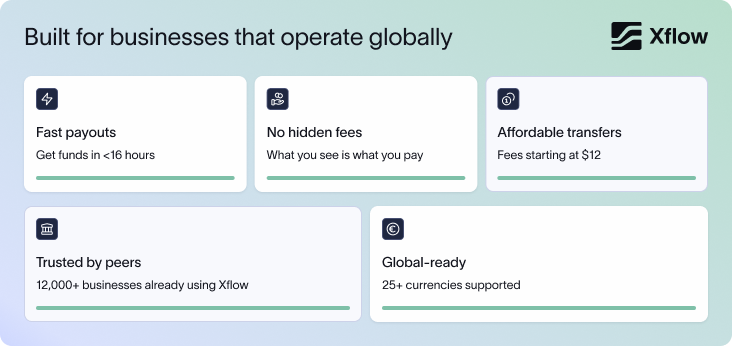
- Receive payments from 140+ countries across 25+ currencies
- Collect all payments on a single invoice
- Automatically generate eFIRA and FIRC for transactions
- Integrate with fintech platforms with API-driven solution
- Maintain high security standards with ISO 27001 and SOC 2 certifications, with support from the world’s largest banks
With dedicated support and comprehensive onboarding, Xflow is a preferred payment option globally. To find out more, visit Xflow today.
Xflow's receiving accounts auto-generate that eFIRA and FIRC paperwork for every payment, so you are not chasing documents after the fact.
Frequently asked questions
The difference between the two documents is in the message that they signal. A FIRA shows that money has been received from across the border. A BRC shows that the funds received have been linked to an export obligation.
No. FIRA cannot be a replacement for BRC. A BRC specifically links the received funds to an instance of export, whereas FIRA does not establish such a link.
BRC and FIRA are issued by the exporter’s bank. BRC is uploaded on the DGFT portal.
Yes, the Bank Realisation Certificate or the BRC is mandatory for goods export. It serves two purposes: giving the exporter access to various incentives and benefits, and compliance with the latest RBI guidelines.
Any export incentives that require proof of inward remittances will require the FIRA, or the Foreign Inward Remittance Advice.
Yes. FIRA is one of the documents required for GST refunds. It is the primary proof that you have received foreign currency in your Indian account.
BRC will typically contain your identification details, shipping bill number, invoice information, payment amount and date, and currency conversion details. Likewise, FIRA will contain information about you, the client, the purpose of the payment, currency information and the date and amount of the payment.
First, you need to log in to the DGFT portal using your credentials. You will find a section titled “e-BRC”. Here, you can find and download your BRC after providing your IEC (Importer-Exporter Code). Do all banks issue BRC or only FIRA?
FIRA is required for export compliance by the RBI. However, you will need other documents, such as the BRC, to link inward remittances to fulfilled export obligations.
An e-BRC is an Electronic Bank Realisation Certificate. It is the modern, electronic form of the BRC, that is used for compliance in export in India.
FIRA cannot be converted into BRC, because the documents are issued for different purposes.
Yes. Usually banks will charge a small issuance fee for BRC.
If you do not have a BRC, you cannot reliably prove that the inward remittance received in your account was for the purpose of an export. It can lead to compliance issues, and block you off from receiving GST benefits and other export incentives.
For compliance, a BRC (Bank Realisation Certificate) is needed. Its RBI-recognised proof of export proceeds. FIRA will only help you prove inward remittance.