What is a SWIFT Code?
SWIFT (Society for Worldwide Interbank Financial Telecommunication) code is a unique identifier used by banks for international money transfers. It allows banks to communicate securely with each other and ensures that funds are routed to the correct bank and branch.
Benefits
- 01Global Recognition: Recognized by banks and financial institutions worldwide for verified transfers.
- 02Security: Ensures funds are routed to the correct bank and branch, minimizing transfer errors and risks.
- 03Speed: Enables quicker and reliable processing of international payments across global banking networks.
- 04Standardization: Provides a uniform format that simplifies and streamlines global payment communication.
Use-cases
- 01Used by individuals and businesses to receive overseas payments accurately and without delays.
- 02Helps organizations send payments to international partners or suppliers securely and on time.
- 03Enables users to validate a bank’s SWIFT code before initiating cross-border transfers.
- 04Used by platforms and companies to manage large-scale or recurring international payments efficiently.
Understanding the SWIFT Code format
SWIFT codes follow a standardized format of 8 or 11 characters that identify banks worldwide. Here's how they break down:
- 01Bank Code: 4 letters representing the bank, often resembling an abbreviation of the bank’s name.
- 02Country Code: 2 letters representing the country (ISO standard code).
- 03Location Code: 2 letters or digits identifying the bank’s city or location.
- 04Branch Code: 3 letters or digits (optional) identifying a specific branch. XXX denotes the bank’s primary office.
Xflow vs SWIFT
Feature | ||
|---|---|---|
Speed | Same or next day | 1–5 days |
Fees | Transparent pricing | High and unpredictable |
Tracking | Real time | Limited |
Exchange rates | Mid-market rate (MMR) | Limited |
12,000+ customers trust us for international payments
Details required for a SWIFT transfer
01
Recipient's Details: Full name, address, and bank account number of the person or business receiving the funds.
02
Bank Details: Bank name, branch address, and the correct SWIFT/BIC code of the recipient’s bank.
03
Transfer Information: Amount, currency, and purpose of the transfer.
04
Identification Details: Identification and compliance documents may be required by the sending or receiving bank depending on the transaction value, corridor, and regulatory requirements.
Frequently asked questions
A SWIFT code is a unique identifier code that helps the transacting banks recognize each other during international money transfers. It’s usually 8 or 11 characters long and includes details such as the bank’s name, country, and branch.
You can find your bank’s SWIFT code using Xflow’s SWIFT Finder tool. Just enter your bank name and country to get the correct code instantly. You can also check your bank statement or online banking page for confirmation before sending an international transfer.
No, SWIFT and IFSC codes are not the same. SWIFT codes are used for international transactions, while IFSC codes are used for domestic transfers within India through methods such as NEFT, RTGS, or IMPS. Both the codes help in identifying banks, but they work in different payment systems.
Yes, SWIFT code and BIC (Bank Identifier Code) are the same. “SWIFT” is the network that assigns these codes, and “BIC” is the official term used in the ISO standard.
No, all banks do not have SWIFT codes. Only banks and branches that handle international payments are assigned one. Smaller banks or local branches may be using the SWIFT code of a correspondent or partner bank for cross-border transactions.
When an international transfer is made, the SWIFT code helps route the payment to the correct bank. It ensures that the funds reach the intended institution securely and accurately.
An 8-character SWIFT code identifies the bank and country, and defaults to the head office. An 11-character code adds a 3-character branch suffix for routing to a specific branch. When you see "XXX" as the suffix, it still refers to the head office.
No, for SEPA payments within the Eurozone, only an IBAN is required. However, for international wire transfers outside the SEPA zone, a SWIFT/BIC code is mandatory.
Yes. SWIFT codes can change following a merger, acquisition, branch closure, or rebranding. Always verify the current code with the recipient bank before initiating high-value transfers.
The transfer may be rejected and returned, or in some cases misrouted to the wrong bank. Returns typically take 3–7 business days. Investigating and recovering a misrouted wire can involve a tracer fee (typically $25–$75) and may take 2–4 weeks.
Yes. US banks use SWIFT/BIC codes for international transfers and ABA routing numbers for domestic transactions. Some US banks have separate SWIFT codes for USD wires versus foreign currency (FX) wires. You need to confirm which applies before sending.
Yes. To receive an international wire into an Indian bank account, you typically need to provide the bank's SWIFT code, your account number, the IFSC code, and an RBI-mandated purpose code. The purpose code is required for the bank to issue a FIRC (Foreign Inward Remittance Certificate), which serves as proof of foreign remittance.
MT103 is the standard SWIFT message format used for international single customer credit transfers. It contains full transaction details including details of the sender, recipient, amount, currency, and charges and is commonly used as proof of payment.
No. SWIFT codes are used exclusively for traditional bank-to-bank wire transfers. Cryptocurrency transactions operate on separate blockchain networks and do not use SWIFT infrastructure.
When two banks don't have a direct relationship, a correspondent (intermediary) bank facilitates the transfer between them. The correspondent bank's SWIFT code identifies this intermediary in the transaction chain. Correspondent banks typically deduct a lifting charge ($10–$30) from the transfer amount, which is why the recipient may receive slightly less than the amount sent.
Do you also need an IBAN Code?
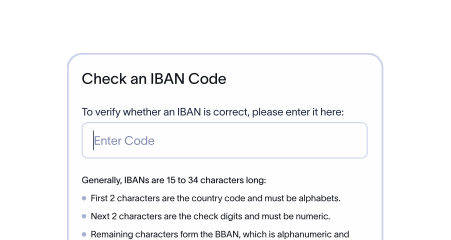
Many transfers require both IBAN + SWIFT, check out our IBAN validator to validate your IBAN quickly.
Data Source
SWIFT/BIC data cross-checked against publicly available banking references and institution-published information.
Last Reviewed: 20/05/2026