Introduction
Blockchain, introduced to the world only in 2008, has radically changed payments over its lifetime. Cryptocurrencies exist alongside traditional payment methods and offer many conveniences.
For businesses that operate across borders, it’s important to understand both traditional and technologically advanced methods of payment. This article will cover ACH and stablecoins, two increasingly relevant payment rails from these worlds.
In this guide, you'll learn what ACH (Automated Clearing House) and stablecoins are, how they differ in speed, cost, and settlement, and their respective use cases. You'll also discover security considerations, regulatory frameworks, integration requirements, and how both rails fit into the future of domestic and cross-border payments.
Key Takeaways
- Understanding ACH vs Stablecoin helps businesses choose the right payment rail for each use case, ACH for domestic US payroll/bills, stablecoins for fast cross-border settlements.
- ACH is a regulated US bank network (run by NACHA) with 1-3 day batch settlement; stablecoins run on blockchain with near-instant settlement.
- ACH fees are $0.20-$1.50 per transaction plus overhead; stablecoin fees are typically under $1 (network gas fees only).
- ACH is tightly regulated under US banking law; stablecoin regulation is still evolving (GENIUS Act, MiCA, etc.).
- For Indian businesses: ACH is inaccessible (US-only) and stablecoins face 30% VDA tax + 1% TDS. Xflow's FEMA-compliant infrastructure is the practical cross-border alternative.
What is ACH (automated clearing house)?
ACH, also known as Automated Clearing House, is an American financial network that enables electronic money transfers.
ACH transfers are payments made using the ACH network. They are commonly used for taxes, refunds, business payments, donations, and consumer bills. In the USA, the ACH is managed by NACHA (National Automated Clearing House Association). A group of banks and financial institutions enable these electronic payments, cutting out the need for cash or cheques as intermediaries.
If the acronym is new to you, our explainer on the ACH full form in banking breaks down what each letter stands for.
What is a stablecoin?
Stablecoins are cryptocurrencies that operate on blockchains. Since their value is connected to fiat money or commodities, they are usually considered less volatile.
Tether (USDT) is a well-known stablecoin. Its value is linked to the US dollar at a 1:1 ratio. Another example is Tether Gold (XAUt), which is backed by gold reserves.
Some tokens are also designed to move across several networks; we explain how a cross chain stablecoin works in a separate guide.
What are the key differences between ACH and stablecoins?
One way to think of ACH vs stablecoins is as traditional methods of money transfer vs newer, blockchain-based payment methods.
To understand the differences between ACH and stablecoins, we’ve created an illustrated comparison using a table:
| Parameter | ACH (Automated Clearing House) | Stablecoins |
|---|---|---|
| Nature | Bank-based electronic transfers processed via ACH network | Blockchain-based digital representation of fiat (typically 1:1 backed) |
| Processing Method | Batch processing at scheduled intervals | Peer-to-peer transfers on blockchain |
| Speed & Settlement | 1–3 business days | Near-instant (seconds to minutes) |
| Availability | Limited to banking hours; no weekends/holidays | Always available |
| Cost | Low or free | Typically <$1 (network fee only) |
| Cross-Border Capability | Limited (primarily domestic US) | Seamless global transfers without intermediaries |
| Key Advantage | Cost efficiency and scalability | Speed, global reach |
In the upcoming sections, we’ll walk through these parameters and see how they differ for ACH and stablecoin transfers.
How does the transaction speed differ between ACH and stablecoin?
ACH payments are settled in pre-defined batches. On top of batch-processing, settlements only occur at scheduled times, on business days. Due to these restrictions, it takes 1 – 3 business days to clear a typical ACH transfer.
On the other hand, stablecoin transfers happen almost instantly. Because they run on blockchain networks, with no cut-off times, you can expect your payment to settle in minutes, if not seconds.
How do the costs and fees compare between ACH and stablecoin?
Many factors affect the cost of ACH transfers. The expected flat fee is between $0.20 – $1.50. On top of it, you can expect a fee per month, chargeback, rejection, batch, and other miscellaneous fees. Businesses with high volumes of ACH transfers can negotiate for lower rates, but the miscellaneous costs add up quickly.
Stablecoins are considerably cheaper. Based on the load on the blockchain network being used, there could be small network transaction fees.
How does transparency and traceability work?
ACH transfers are settled by banks, reducing transparency into the transaction.
But owing to the technologically advanced nature of a stablecoin settlement, transactions have real-time visibility. All transactions are recorded on public blockchain ledgers. With transaction IDs, you can verify transactions, track their status, and confirm payment receipt in a quick, hassle-free way.
What are the settlement mechanisms?
A typical ACH transfer will follow these steps:
- You will provide the sender with your bank details.
- When they initiate the transaction, the involved bank will make a fund transfer request.
- The transfer will happen if all information in the transfer request is valid, and if enough funds are available to be transferred.
Stablecoin transfers follow a different settlement mechanism:
- The sender will initiate a stablecoin transfer.
- The sender’s wallet will broadcast to the relevant blockchain network.
- The transaction now enters the network’s mempool, where it is included in a “block.”
- The transaction is immediately settled.
An interesting characteristic of blockchains is that they do not support chargebacks. This means that a confirmed payment cannot be pulled back.
What are the pros and cons of using stablecoin for cross-border payments?
Stablecoins and similar cryptocurrencies are becoming more popular worldwide for cross-border payments. If you run an international business, you may want to consider them over traditional payment methods.
For a direct comparison with bank wires, see our breakdown of stablecoin vs wire transfer.
Here are reasons why stablecoins have found popularity in the cross-border payments field:
Speed of transactions
Stablecoin settlements happen on the scale of minutes and seconds, instead of the hours and days that ACH transfers and similar traditional transaction methods take. In a fast-paced business environment, this quality is very desirable.
Low fees
Stablecoins do not come with the plethora of miscellaneous fees that traditional money transfer methods do. For multiple, multi-currency transactions, stablecoins are preferable.
No intermediaries
Stablecoins go from the payer to the payee without any intermediaries.
Transparency
Stablecoin transactions are completely traceable, end-to-end, leaving no room for ambiguity.
Finality
Stablecoin settlements are both instant and final. Any refund or pullback has to be manually initiated as another transaction, which reduces counterparty risk.
Despite these lucrative benefits, some businesses have reservations about stablecoins. Because the regulatory landscape for stablecoins and other digital currencies is still developing, and because stablecoins are more volatile than traditional currencies, hesitations for wide-scale adoption remain. Let’s look at them in the upcoming sections.
What are the security considerations?
For each payment method, a business owner has to consider multiple things — data protection, transaction risk, etc.
ACH operates within the NACHA network, owned by regulated banks, credit unions, and other financial institutions. All the transactions happening within the network are tightly regulated, too. The users of this legacy system can conduct their transactions while staying assured of security.
Stablecoins have a different security model. The security of the data is introduced through blockchain and cryptography technology. Some users might be concerned about the risks that could come with compromised keys, or hacking. The major advantage of stablecoins is that there are no chargebacks. This eliminates the risk of any chargeback fraud.
What are the regulatory and compliance aspects of ACH and stablecoin?
As a legacy system, ACH has been around for over 50 years. Regulations and compliance have been built into the system. Administered by NACHA and its member financial institutions, ACH provides its users with a money transfer system that is very well standardized.
Stablecoins have gained popularity, but on shaky regulatory foundations. Across the globe, frameworks are still evolving. In the USA, the GENIUS Act is one such example of an attempt to regulate stablecoin usage.
We go deeper on what meeting these rules involves in our guide to stablecoin compliance.
Stablecoins also pose other risks. Stronger KYC checks, an increase in interoperability of stablecoin networks, and better currency conversions are some steps that can help reduce those risks. But even the adoption of these steps varies, region to region.
What are the use cases for businesses and individuals?
ACH use cases
ACH is most suitable for routine and high-volume transactions. These transfers are also a great fit for domestic transfers.
Businesses can use them for:
- Payroll and direct deposits for employees
- Recurring payments (subscriptions, EMIs)
- Vendor payments on scheduled cycles
- Internal fund transfers
Individuals can use them for:
- Paying utility bills and loan EMIs
- Receiving salaries, tax refunds, or government benefits
- Transferring money between personal bank accounts
Stablecoin use cases
Stablecoins are great for international payments, especially where time is of the essence.
Indian businesses receiving in stablecoins should also review the rules around stablecoin b 2 b payments india offramp compliance.
Businesses can use them for:
- Cross-border payments
- Vendor payouts
- Supplier settlements
- Treasury management
Individuals can use them for:
- Sending international payments, quickly
How can both these payment methods integrate with your existing system? Let’s find out.
How do ACH and stablecoin integrate with financial and digital systems?
It’s important for payment methods to fit in well with your existing financial and digital systems. As a business owner, you might ask if you’ll need additional tools to make the system work.
ACH
If your business is located in the USA or makes payments to the USA, ACH transfers will fit well with your infrastructure. ACH connects directly with business bank accounts and is supported by most financial institutions. Many businesses find that ACH is compatible with their ERP and payroll systems. The way transactions are processed and settled on ACH makes it reliable and predictable.
Stablecoins
For future-forward businesses, stablecoins are the way to go. Because they are built on blockchain, they require integrations with wallets and blockchain APIs.
With these integrations in place, you can enjoy quick settlements for all your cross-border transactions.
What is the future of payments: traditional vs blockchain-based systems?
Stablecoins are just one example of blockchain making its way into finance. How will payments change, going into the future?
The most likely scenario is that all entities — financial institutions, businesses, individual users — will utilize systems based on their strengths and weaknesses.
Traditional payment methods, including ACH, will continue to be a domestic payment backbone. Blockchain-based options will provide faster and more flexible payments for those who need it.
With better regulations in place, more people are turning to cryptocurrencies. The future of payments is still taking shape.
Conclusion
As the world migrates to modern payment technologies, make sure your business is not left behind. Picking the right payment partner, in this day and age, can make a world of difference.
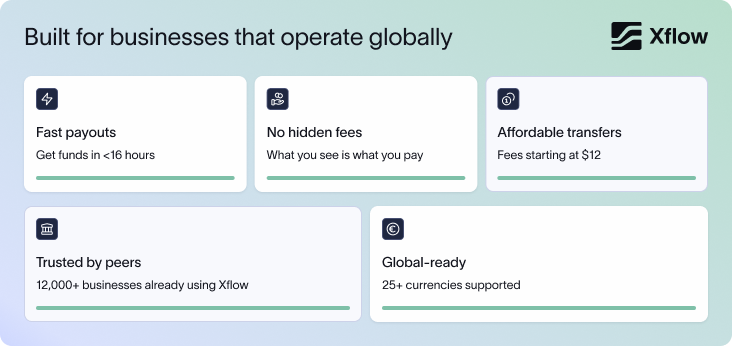
Payment platforms like Xflow can greatly simplify your international transactions. With Xflow, you can:
- Receive international payments from 140+ countries in 25+ currencies
- Track payments in real time from initiation to settlement
- Access mid-market FX rates with fully transparent pricing
- Generate eFIRA automatically for every transaction, keeping you compliant
- Enjoy API access to major fintech platforms
- Ensure security with ISO 27001 and SOC 2 certified systems
- Manage all payments on a single invoice
All these services, offered with quick digital KYC and efficient onboarding, make Xflow one of the leading payment platforms in the market today. Visit Xflow to find out more.
If stablecoins are the route you are considering, Xflow also supports stablecoins, settling those payments directly into INR so you do not have to manage crypto volatility yourself.
Frequently asked questions
ACH is a network of financial institutions through which electronic money transfers can happen. Stablecoins use blockchain-based technology to transfer money.
In practice, stablecoins for payments are significantly faster. Although same-day ACH transfers have become more common, stablecoin transactions can be settled on the scale of seconds and minutes.
The transaction fee for ACH transfers is generally low. People can expect a lot of overhead and miscellaneous fees. Expedited transfers can cost more money. Stablecoins charge no intermediary fee or FX markups, making them very low-cost.
Because stablecoin transactions are stored on blockchain ledgers, you can track them easily through transaction IDs and timestamps. ACH transfers are not as transparent.
Stablecoins have more reach than ACH for cross-border payments, but it’s unlikely for either of the methods to replace the other entirely, for any purpose.
Stablecoin transactions are considered secure because they can reduce counterparty risk. ACH transfers are governed by a large and regulated network of financial institutions — making them inherently secure. But the risk of fraud remains.
ACH transfers are tightly regulated and managed by a large network of financial institutions in the USA. The regulatory landscape for stablecoins is not well-developed. The GENIUS Act in the USA is an example of a newly established regulatory framework for stablecoins.
For international businesses that often need fast settlement speeds, cross-border transfers, and consistent availability, stablecoins are a better option. ACH transfers might suit the types of businesses with regular, routine payments.
ACH transfers occur using a different technological infrastructure compared with blockchain. It is both possible and ideal for the two payment methods to coexist in the future.
Stablecoins are less regulated and less suitable for high-volume domestic payments. In cases where businesses need highly regulated environments, ACH is the obvious choice.
ACH transfers are processed in batches. Because of this settlement method, an ACH transfer can take 1-3 business days. Stablecoin settlements happen on a blockchain on an individual basis, which allows for shorter transaction times.
Stablecoins are generally accepted globally. Yet the universal acceptance of ACH transfers in the USA is a lot higher.
Banks play a fundamental role in ACH transfers because they’re the primary intermediary, from the initiation to the settlement stage. Stablecoins are more reliant on blockchain networks. Here, banks provide the means to convert cryptocurrency into fiat currency and vice versa.
Of cryptocurrencies, stablecoins are considered the least volatile. But because their value is pegged to a fiat currency or a commodity, the value of stablecoins is subject to change, too.
According to NACHA, ACH and stablecoins are expected to evolve side-by-side in the future. Stablecoins will eventually bridge technological innovations like blockchain and traditional means of money transfer, like the ACH.