Introduction
Moving money across borders has always been challenging, until now. In the last decade alone, many new payment methods have evolved, and then changed how businesses make their payments.
Out of the list of these new payment methods, chances are you’re already familiar with stablecoins. If you’re frequently transacting across borders, you might be interested in the finer details and how stablecoins can be integrated into your payment processes.
If you still send money the traditional way, our stablecoin vs swift comparison shows how the two rails differ.
In this guide, you'll learn what USDT (Tether) and USDC (USD Coin) are, who issues them, and how their backing and collateral mechanisms differ. You'll also discover transparency and auditing practices, transaction speed and cost, security and regulatory considerations, market adoption, use cases for trading and payments, risks, and how to choose the right stablecoin for your business.
Key Takeaways
- Understanding USDT vs USDC helps businesses and investors choose the right stablecoin for their use case balancing liquidity, compliance, transparency, and regional acceptance.
- USDT (Tether) is the largest stablecoin (~$117B+ market cap), highly liquid, and dominant in Asia and emerging markets, but faces ongoing transparency concerns.
- USDC (USD Coin) is the second-largest (~$34.9B market cap), fully backed by cash and US Treasuries, audited monthly by Deloitte, and preferred for US/EU regulated environments and DeFi.
- Both maintain a 1:1 USD peg but differ significantly in backing composition, regulatory oversight, and transparency practices.
- For Indian businesses: Both USDT and USDC trigger India's 30% VDA tax + 1% TDS under Section 115BBH at INR conversion. Operational use is heavily taxed regardless of which stablecoin you choose.
What is USDT (Tether)?
USDT is a stablecoin that is provided by Tether Limited. Its value is pegged to the US dollar, 1:1. It’s been around since 2014, which makes it one of the earliest stablecoins. This early release is a big reason why it’s still the most widely used today.
Initially, it supported only the Bitcoin blockchain. Over time, its network spread across Ethereum, Solana, Avalanche, among others. It has the highest market capitalization of all stablecoins.
What is USDC (USD Coin)?
Similar to USDT, USDC is a stablecoin issued by Circle. It is likewise pegged to the US dollar, 1:1.
USDC was co-founded in 2018 by Coinbase and Circle, but has been managed solely by Circle for a while. Compared to USDT, it’s newer. Still, it’s a popular stablecoin because of Circle’s strong commitment to transparency.
What are the key differences between USDT and USDC?
USDT and USDC are both dollar-pegged stablecoins, so there are some operational similarities. The differences become clear, largely in regard to regulation and use cases.
Let’s explore these differences using a comparison table.
| Aspect | USDT | USDC |
|---|---|---|
| Backing | Mixed assets, fiat currency, loans, Treasury, etc. | Fully backed by fiat reserves |
| Transparency | Lower. Provides attestations | Higher. Regular, independent audits, and attestations |
| Regulation | Less regulated | Strong compliance with US regulatory guidelines |
| Adoption | Largest stablecoin by market cap and trading volume; dominant globally | Second-largest stablecoin; strong but lower market share |
| Use case | Crypto trading, liquidity, exchange usage | DeFi, institutional use, compliance-focused applications |
| Risk | Considered higher due to transparency issues | Considered lower |
| Best for | Active trading | Long-term holding |
Now, we will explain why these differences exist. We’ll begin by looking at their issuers and governance structure.
Who are the issuers and what is the governance structure?
Both USDT and USDC are US dollar-pegged stablecoins. The differences begin with their issuers and governance structures.
- USDT is issued by Tether Limited, and was first launched in 2014 as “Realcoin”. After a series of changing banking partners, Tether was able to find some stability. Tether is registered in the British Virgin Islands. As the first stablecoin in the market, USDT has been widely adopted across the world.
- USDC is issued by Circle and Coinbase. It was launched in 2018. It is an ERC-20 token that is also available on other blockchain platforms. USDC is listed on the New York Stock Exchange. Circle is the sole institution responsible for its management today.
In the next section, we’ll see how these stablecoins are backed.
How are USDT and USDC backed?
Stablecoins maintain their value by being pegged to stable assets. USDT and USDC are “fiat-collateralized” stablecoins, so their value is linked to a fiat currency (in this case, the US dollar).
Check today's rupee value for any amount with our USDT to INR calculator and USDC to INR calculator.
- USDT is backed by a mix of cash, US treasury bills, reverse repos, alongside secured loans, bitcoin, gold, and other investments by Tether. The exact composition of the backing assets was not always disclosed transparently, but over time, Tether has reallocated reserves towards US Treasury bills and reverse repos.
- USDC takes a more straightforward approach to backing. It’s backed completely by cash, US Treasury bills and reserve repos. These reserves are held with regulated banks and within an SEC-registered government money market fund.
So the two differ in their backing mechanisms. USDT has a more diversified pool of backing assets, while USDC relies on more regulated assets.
Both coins are created the same way against those reserves; our guide to stablecoin minting shows how issuers mint new tokens.
How do USDT and USDC compare in transparency and auditing?
Transparency and auditing for each of these stablecoins is another hot topic. There have been some historical controversies for USDT.
- USDT provides reserve reports and attestations on a quarterly basis. Regular, comprehensive public audits have still not happened. In the past, USDT has also faced regulatory penalties.
- USDC is considered the more transparent stablecoin of the two. Circle conducts regular independent audits with third-party companies like Deloitte. The audit results are publicly available. It also provides information about reserves and their distribution. USDC has been under the regulation of American authorities from its launch, increasing its transparency and trust value.
How do USDT and USDC compare in transaction speed and cost?
The benefit of operating on blockchains is that transactions made in stablecoins will settle quickly. There are some nuances to transaction speeds and costs:
- USDT is commonly used on networks like Tron, where it is able to offer low transaction fees. On other networks like Ethereum, transaction costs can be higher.
- USDC offers lower costs and fast settlements on networks like Solana and Layer 2 solutions. It is well-suited for frequent, high-speed transactions.
Now, we’ll take a look at the security and regulatory considerations of both USDT and USDC.
For how this settlement speed stacks up against an old-school bank wire, see our stablecoin vs wire transfer comparison.
What are the security and regulatory considerations?
When it comes to modern payment technologies, safety can become a big concern. Here’s what you need to know for both USDT and USDC, and stablecoins in general.
- Although blockchain is secure, there remain concerns about hacks and platform issues.
- USDT has faced many concerns and even penalties in the past regarding its transparency practices. Although its reporting practices have evolved over the years, USDT still does not release quarterly public audits.
- USDC is listed on the NYSE, registered in the USA, and releases regular public audits. The trust among users is high.
- On the regulatory side, USDC follows American compliance standards. USDT is based offshore, leaving some room for ambiguity in its compliance.
Another point to consider here is that regulation of stablecoins across the world is only beginning. In 2025, the American government introduced the GENIUS Act. It was designed to introduce regulation into stablecoin operations. It requires that stablecoins are fully backed, regularly report their reserves, and follow various AML (Anti-Money Laundering) Guidelines. Other regions (the EU, Japan, Singapore, UAE) have also introduced or proposed similar frameworks.
So the overall safety of the stablecoin is a combination of its issuer’s security practices and its region of operation.
How do USDT and USDC compare in market adoption and liquidity?
USDT is the most widely used stablecoin in the market. It has the highest trading volume, by a large margin. And because it has trading currency pairs on almost all major platforms, it also boasts the most liquidity. It’s most widely used in Asian and other emerging markets. This widespread popularity is also a result of USDT being the first stablecoin in the market.
USDC is smaller in comparison. Although it has lower liquidity than USDT, it’s still a large player in US-regulated markets and plays an important role in trading and DeFi.
As of 2024 reports, USDT has a market capitalization of over $117 billion, and that of USDC is about $34.9 billion. This is a large difference, but in recent years, USDC has been shortening this gap and is projected to grow.
What are the use cases for USDT and USDC in trading, payments, and DeFi?
Stablecoins like USDT and USDC have many applications, as we will see in this section.
Trading & liquidity
Stablecoins are commonly used as “base pairs” on crypto exchanges. This means traders can buy and sell other cryptocurrencies using USDT or USDC instead of converting back to traditional money. This makes trading more convenient.
For frequent traders, USDT is the stablecoin of choice.
Cross-border payments
Stablecoins work on blockchains. It makes them fast and cheap, especially compared with other forms of bank transfers. Stablecoins can help you send money internationally in minutes, useful for both remittances and business payments across the globe.
DeFi
DeFi, also called decentralised finance, refers to financial services built on blockchain. Stablecoins are the common form of currency in this use case.
Business use
Stablecoins are used by international businesses for making payments and treasury management.
Everyday payments
Finally, stablecoins like USDC and USDT are also being used to make regular payments.
What are the risks and limitations of each stablecoin?
Each coin comes with some limitations. Let’s look at each of them.
USDT
USDT’s biggest concern is transparency. Not only has Tether faced penalties and regulatory scrutiny in the past, but its lack of regular audits is still a concern. As a currency, USDT is also centralized, which means that it is controlled by Tether alone.
USDC
USDC’s biggest concern is lower global adoption. USDC is a less liquid option for people who want to use stablecoins. It’s more expensive on blockchain networks like Ethereum, and also has a large degree of centralisation.
How should businesses and investors choose between USDT and USDC?
With these characteristics and features of each stablecoin in mind, how can businesses make the right choice? It depends on your business type and what you wish to use stablecoins for.
It’s best to pick USDT if:
- You operate in regions like Asia, Southeast Asia, Africa, or Latin America
- You need high liquidity in your operations
- Your partners already use USDT and prefer it for payments
- Your want low-cost networks like Tron
And it’s ideal to choose USDC if:
- Your business partners are in the US or EU
- You don’t want to rely on an exchange
- Your partners or platforms operate within more regulated environments
- Your partners already use USDC and prefer it for payments
- You want networks like Ethereum, Solana, or Base
As a business owner or investor, you also have the option of using both USDC and USDT. It’s best if your business works in multiple regions across the world, if you’re building payment systems where users can hold both USDC and USDT, and if you just want to avoid any extra conversion steps on receiving money.
What is the future outlook for both stablecoins?
With time, stablecoins like USDT and USDC have shed their shell of being just “crypto tools”. The market capitalisation and usage speak for themselves, stablecoins are here to stay.
As more and more payments move across the borders and payment systems themselves become more digitised, stablecoins are expected to continue to grow. USDT will probably maintain its position in liquidity and trading. USDC, already growing, is best for regulated environments.
As countries around the world increase emphasis on regulations, stablecoins are bound to gain more public trust in the future.
Conclusion
Making the choice between USDT and USDC for your business will come to what you need, whether it is liquidity, compliance, or something else. For businesses, it’s important to meet all these requirements, especially when they are operating across the border.
For these businesses, finding the right payment partner is quintessential, and that is exactly what Xflow has to offer:
- Collect cross-border payments from 140+ countries in multiple currencies
- Offers fast settlements, with funds credited in as little as 24 hours
- Allows 24×7 withdrawals and currency conversions
- Get mid-market FX rates, transparent pricing, and no hidden fees
- Offers real-time tracking of payment status from initiation to settlement
- Automatically generates eFIRA for compliance
- Offers API-based infrastructure for businesses
- Ensures secure transactions with ISO 27001 and SOC 2
If your business already holds or moves funds in USDT or USDC, Xflow's own stablecoins support lets you convert and settle them directly into your local account.
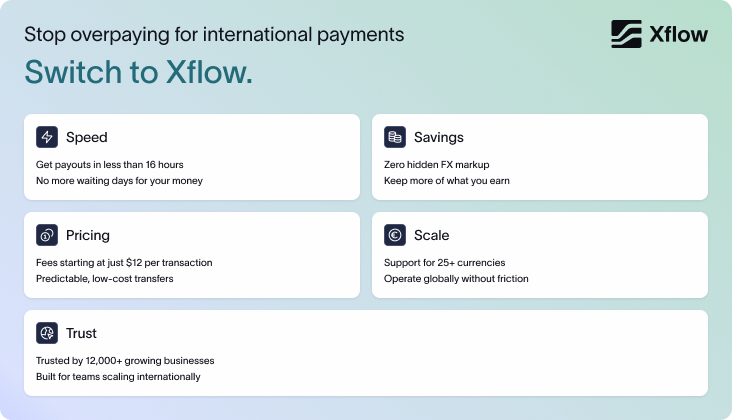
So if you have been looking for the right payment partner, look no further. Check out Xflow today, and simplify your cross-border payments.
Frequently asked questions
The USDT is issued by Tether, and backed by a mix of cash, treasuries, and loans. The USDC is issued by Circle, and is backed completely by cash and treasuries. They’re also different in the degree of compliance and liquidity they can offer to users.
The USDT is issued by Tether Limited, and the USDC is issued by Circle.
USDT is backed by a diverse mix of cash, Treasuries, loans, and other investments held by Tether. USDC is backed by cash and Treasuries, mostly.
Between the two, the USDC is considered more transparent. Circle releases auditing reports to the public regularly. The audits themselves are conducted by a third-party firm (like Deloitte). And because the USDC is registered on the New York Stock Exchange, it follows the compliance needs of the USA.
There are no major differences; speed and cost end up largely similar. The speeds depend on the blockchain network they operate on, but both transactions happen quite fast. Ethereum-based transactions are typically more expensive.
The USDC is more tightly regulated. It follows compliance rules in the USA, is listed on the NYSE, and provides regular audited reserve disclosures. The USDT’s regulation status has been under scrutiny for a few years now.
USDC is considered safer. Circle abides by the regulatory requirements of the USA, making USDC a more transparent option.
Both USDT and USDC are widely adopted in trading and DeFI (decentralised finance). As stablecoins, they offer liquidity and price stability to users, making them well-suited for such use cases.
USDT has historically faced concerns about reserve transparency. USDC depends on major banks for its reserves, but there are risks of collapse. Both stablecoins face regulatory uncertainty.
Yes. Stablecoins like USDT and USDC can be used by modern businesses for making payments, as they are cost-effective, quick, and gaining traction worldwide.
USDT is considered more liquid. This is because the USDT has several trading pairs, and very high daily volumes. The USDC is considered more liquid on decentralised exchanges.
The USDC is audited on a monthly basis by independent firms like Deloitte. Circle also provides weekly disclosures. The USDT is audited on a quarterly basis, but these are not “full” audits. Instead, Tether releases quarterly attestation reports.
USDT is the most common in cross-border transactions, while the USDC is more common in the USA and Europe.
Today, both USDT and USDC coexist in the crypto ecosystem. They have different strengths, cover different needs, hence many stablecoin users opt for both.
In the near future, USDT is expected to stay dominant, because of its high liquidity. USDC is more accepted and expected to grow in regulated markets and DeFi.