Swift code Finder

Deutsche Bank Ag SWIFT / BIC Codes | All Branches

Here’s the verified SWIFT/BIC code for this branch. Use this code to make secure international transfers without delays.

Swift Details

DEUTZAJXXXX

Code Found

Bank Name

DEUTSCHE BANK AG

Location

SANDTON, SOUTH AFRICA

Address

MAUDE STREET, 87, EXCHANGE SQUARE 3

What is a SWIFT Code?

SWIFT (Society for Worldwide Interbank Financial Telecommunication) code is a unique identifier used by banks for international money transfers. It allows banks to communicate securely with each other and ensures that funds are routed to the correct bank and branch.

Benefits

  • 01
    Global Recognition: Recognized by banks and financial institutions worldwide for verified transfers.
  • 02
    Security: Ensures funds are routed to the correct bank and branch, minimizing transfer errors and risks.
  • 03
    Speed:  Enables quicker and reliable processing of international payments across global banking networks.
  • 04
    Standardization: Provides a uniform format that simplifies and streamlines global payment communication.

Use-cases

  • 01
    Used by individuals and businesses to receive overseas payments accurately and without delays.
  • 02
    Helps organizations send payments to international partners or suppliers securely and on time.
  • 03
    Enables users to validate a bank’s SWIFT code before initiating cross-border transfers.
  • 04
    Used by platforms and companies to manage large-scale or recurring international payments efficiently.

How should the MT103 message be formatted for Deutsche Bank Ag?

An MT103 for Deutsche Bank Ag must include the SWIFT code in field F57, the recipient's full legal name and IBAN/account in F59, and a clear purpose of payment in F70.

FieldGuidance
:50K (Ordering Customer) Enter the sender’s full legal name, account number or IBAN (if required), and registered address exactly as maintained by the sending bank. For businesses, use the registered legal entity name rather than a trading name or abbreviation.
:57A: (Beneficiary Bank) Enter the beneficiary bank’s SWIFT/BIC code. Some banks may require the 11-character branch BIC instead of the 8-character primary office BIC for accurate routing.
:59: (Beneficiary Customer) Enter the recipient’s full legal name and IBAN or account number exactly as registered with the receiving bank. Include any required local routing details where applicable.
:70: (Reason for Payment)Provide a clear payment purpose or invoice reference. Field :70: supports up to 4 lines of 35 characters each. Some corridors require regulatory purpose codes.
:71A: (Charges)SHA: shared charges. OUR: sender pays charges. BEN: recipient pays charges. Confirm charge preferences with the beneficiary before sending.

PRO TIP: Name mismatches may trigger additional compliance review or payment delays, especially for cross-border transfers.

What happens if you use the wrong SWIFT code for Deutsche Bank Ag?

Using the wrong SWIFT code can cause the wire to be rejected, returned in 3-7 days, or routed to the wrong institution. If the SWIFT code is incorrect, the payment may be delayed, rejected, or returned. Additional intermediary, return, and repair charges may also apply.

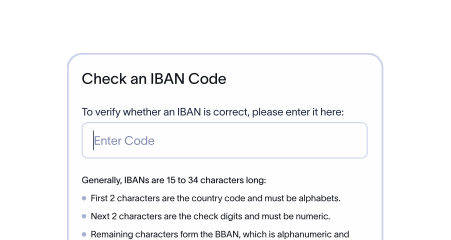
Do you also need an IBAN Code?

Many transfers require both IBAN + SWIFT, check out our IBAN validator to quickly validate your IBAN Code.

Xflow

Frequently asked questions

A SWIFT code is a unique identifier code that helps the transacting banks recognize each other during international money transfers. It’s usually 8 or 11 characters long and includes details such as the bank’s name, country, and branch.

You can find your bank’s SWIFT code using Xflow’s SWIFT Finder tool. Just enter your bank name and country to get the correct code instantly. You can also check your bank statement or online banking page for confirmation before sending an international transfer.

No, SWIFT and IFSC codes are not the same. SWIFT codes are used for international transactions, while IFSC codes are used for domestic transfers within India through methods such as NEFT, RTGS, or IMPS. Both the codes help in identifying banks, but they work in different payment systems.

Yes, SWIFT code and BIC (Bank Identifier Code) are the same. “SWIFT” is the network that assigns these codes, and “BIC” is the official term used in the ISO standard.

No, all banks do not have SWIFT codes. Only banks and branches that handle international payments are assigned one. Smaller banks or local branches may be using the SWIFT code of a correspondent or partner bank for cross-border transactions.

When an international transfer is made, the SWIFT code helps route the payment to the correct bank. It ensures that the funds reach the intended institution securely and accurately.

Data Source

SWIFT/BIC code data sourced from the official SWIFT BIC Directory (ISO 9362) and validated against participating banks' published reference data.

Last Reviewed: 20/05/2026