Introduction
Stablecoins have quietly become one of the biggest forces in digital finance.
In 2025 alone, they moved over $33 trillion in transaction volume, more than many traditional payment networks. And they’re no longer just used for crypto trading. Today, they’re being used for cross-border payments, treasury management, and everyday transactions.
But here’s the catch.
The more quickly stablecoins develop, the more interest regulators show in them. The initial environment, which was all about flexibility and innovation, is turning into one that is bound by regulations and high standards.
If you’re using or building with stablecoins, this shift matters.
Because it’s no longer just about speed or efficiency, it’s about whether your system can actually hold up under regulatory scrutiny.
It’s not about fast performance anymore; it’s about the ability to withstand regulatory pressure.
In this guide, you'll learn what stablecoin compliance means, which regulatory bodies oversee stablecoins globally, and the key compliance requirements (KYC, AML, OFAC, reserve audits). You'll also discover issuer responsibilities, exchange controls, cross-border challenges, risk management best practices, real-world compliance failures, and the future of stablecoin regulation.
Key Takeaways
- Stablecoin compliance helps issuers, exchanges, and businesses build trust with regulators, banks, and users, unlocking institutional adoption, cross-border use, and long-term scalability without operational risk.
- Core compliance layers include KYC (identity), AML (transaction monitoring), OFAC (sanctions screening), and reserve audits/reporting.
- Major regulatory frameworks include FATF (global AML standards), US GENIUS Act (2025 federal stablecoin law), EU MiCA (2024 enforcement), and Singapore/Hong Kong/UAE licensing regimes.
- Non-compliance consequences range from financial penalties to operational restrictions, frozen assets, delisted tokens, and damaged banking relationships.
- For Indian businesses: stablecoins aren't legal tender in India and carry 30% VDA tax + 1% TDS. Xflow's RBI-approved, FEMA-compliant payment infrastructure avoids stablecoin regulatory uncertainty entirely.
What is stablecoin compliance?
Compliance for stablecoins can be defined as the regulatory requirements that govern the issuance and usage of the stablecoin.
Stablecoin compliance is necessary since they operate much like electronic money. Once they are in use for transactions or the storage of funds, regulators will consider them to be part of the financial ecosystem.
Therefore, compliance addresses the following questions:
- Is this stablecoin actually backed by real, liquid assets?
- Can transactions be traced and verified if needed?
- Is there enough protection against fraud and money laundering?
Compliance makes sure of three main aspects:
- The stablecoin is backed the way it claims to be (with clear reserve practices)
- Transactions are traceable and tied to real users
- The ecosystem isn’t being used for illicit activities
Why is compliance important for stablecoins?
When compliance is in place, stablecoins become easier to trust, easier to use, and easier to scale. It supports user confidence, institutional participation, and regulatory alignment—all at the same time.
Here’s why it matters:
- Compliance ensures transparency in how stablecoins are issued, backed, and transacted. This helps maintain confidence among users, institutions, and regulators.
- Without compliance, there may be restrictions on the usage of stablecoins in different jurisdictions.
- Banks and payment providers are more likely to work with compliant stablecoin systems due to reduced regulatory and operational risk.
- Users are more likely to transact and store value in stablecoins when there is clarity around safety, legitimacy, and oversight.
- Regulatory bodies like the FATF or SEC expect that the use of stablecoins complies with international standards for anti-money laundering and financial transparency.
- Strict compliance measures will minimize the risk of stablecoins being used for criminal activities.
- Compliance makes it easier for stablecoins to integrate with global payment systems and operate across jurisdictions.
Which regulatory bodies and frameworks govern stablecoins?
The rules governing stablecoins are not controlled by one entity but are the product of various organizations, each having different mandates ranging from financial stability to anti-money laundering issues.
Now that stablecoins have evolved to become a key component of the payment infrastructure, considering the fact that transactions happening each month are in the hundreds of billions, it seems that the regulators have gone from the advisory stage to the implementation/enforcement stage.
So, who are the main players here?
- Financial Action Task Force (FATF): The FATF is an international body responsible for setting standards related to anti-money laundering (AML) and combating the financing of terrorism (CFT). The Travel Rule of FATF requires the virtual assets service providers to report certain transaction details about the sender and receiver. By 2025, many countries might adopt these regulatory requirements into law.
- Reserve Bank of India (RBI): In India, the RBI is responsible for financial stability, and a very conservative approach has been adopted towards the use of private stablecoins. However, currently, there are no stablecoin laws in India, as most of the focus has been on risk management and CBDCs, particularly the e-rupee.
- U.S. Securities and Exchange Commission (SEC): Stablecoins are analyzed by the SEC from the point of view of securities. Some of the stablecoins that pay interest or are backed by assets could fall under the category of securities.
- Office of Foreign Assets Control (OFAC): The OFAC ensures compliance with sanctions imposed by the US government. This applies directly to stablecoin systems because it is necessary to avoid using wallets, persons, or geographical areas that are subject to sanctions.
For Indian businesses actually settling stablecoin proceeds into INR, the more immediate question is less about stablecoin-specific law and more about how those funds move through existing banking rails. We cover that in Stablecoin B 2 B Payments India Offramp Compliance.
Beyond these, regulation is becoming more structured at the regional level:
- One of the most detailed regulatory regimes for stablecoins was set forth in the Markets in Crypto-Assets (MiCA) initiative from the European Union. This regime involves licensing of stablecoin issuers as well as reserve requirements and strict requirements for transparency.
- In addition, other countries, including Singapore, Hong Kong, and the United Arab Emirates, have introduced a licensing regime for stablecoins.
What are the key compliance requirements for stablecoins?
Compliance requirements for stablecoins should not be treated as a fixed checklist but as a multi-level system based on customer identification, monitoring of transactions, sanctions checks, and reporting.
Let us take a closer look at how it is done:
KYC (Know Your Customer)
The first step in making sure that your system is secure and managing transactions in it is knowing who your customers are.
At least, one can expect that:
- Identity verification should take place using official government documents, including address confirmation, and sometimes even biometric identification
- Screening of users must be carried out based on risk categories (whether an individual, company, country considered high-risk and so on)
- Customer data should be updated regularly, rather than once at the initial stage
As a rule, on most regulated stablecoin platforms, there is also tiered KYC verification, during which transaction limits grow as the degree of verification increases.
AML (Anti-Money Laundering)
While KYC revolves around identifying an individual, AML deals with their behavior.
Stablecoins should keep track of how money flows in the network, not just who sends it.
Key components include:
- Systems for real-time and after-the-fact monitoring of transactions
- SAR filing with authorities when they notice any suspicious activity
- Risk assessment algorithms for pinpointing wallets with high risks, as well as locations and patterns of behavior
For instance, typical examples of suspicious activity include:
- Abrupt increases in transaction frequency
- Structuring behavior (breaking large transfers into smaller ones)
- High-frequency cross-wallet movements in short time windows
These standards have much in common with FATF’s recommendations concerning virtual assets and anti-money laundering/counter-terrorism financing policies. They have been widely implemented across over 200 countries.
OFAC screening
Sanctions compliance is non-negotiable, especially for platforms with global exposure. Stablecoin operators must ensure they are not interacting with:
- Individuals or entities on sanctions lists
- Wallets linked to restricted jurisdictions
Exposure through intermediaries and mixing services
The Office of Foreign Assets Control obliges any American-related party to either block or freeze the funds of anyone who appears on its SDN (Specially Designated Nationals) list.
Consequently, this has resulted in:
- Real-time wallet screening before transaction approval
- Blacklisting of known high-risk addresses
- Asset freezes when sanctions exposure is detected
Even in decentralized environments, compliance layers are increasingly being integrated at the application and infrastructure level.
Reporting and audit obligations
Here is where transparency becomes quantifiable, and here is where regulators put the bulk of their attention.
Generally, stablecoin issuers are supposed to offer:
- Reserve disclosures: Breakdown of what supports the stablecoin (cash, treasuries, equivalent assets)
- Verification through independent attestations or audits: Usually provided by an external accounting firm
- Filings with regulatory authorities: Periodic reporting based on the specific jurisdiction
When it comes to fiat-collateralized stablecoins, there is no doubt: 1-to-1 backing must always be verifiable.
Examples include:
- Monthly or quarterly reserve reports are commonly published by major issuers
- Liquid collateral, such as short-term U.S. Treasuries may be employed to stabilize the currency
- Auditors check that the supply of tokens in circulation matches reserve balances
The trend among regulatory agencies such as the SEC and others worldwide is toward real-time reserve transparency for large-scale issuers of stablecoin.
In the EU’s MiCA framework, for instance, issuers are required to maintain clear redemption rights and transparent reserve management practices, reinforcing the move toward stricter financial-grade oversight.
What are the responsibilities of a stablecoin issuer?
Issuers don’t act as intermediaries between transacting parties like others do. Instead, they are fully liable for the quality of the stablecoin.
Here are some of their key responsibilities:
Reserve quality
Each stablecoin needs to be backed by something valuable. Regulators require this backing to be credible and secure.
Specifically:
- Keeping reserves of safe, low-risk financial instruments such as cash equivalents and short-term government securities
- Liquidity of reserves to satisfy redemption requirements
- Segregation of reserve assets from operational resources
The goal is simple: if users redeem at scale, the system should hold up without disruption.
Redemption clarity
A stablecoin is only as strong as its ability to be redeemed.
Issuers are expected to ensure:
- Clear, predictable redemption processes
- No hidden conditions or operational delays
- Defined settlement timelines for converting stablecoins back to fiat
In well-regulated systems, users should never have to question if they can exit, only how quickly they can do it.
Operational transparency
Trust in stablecoins is built on visibility.
Issuers are generally expected to provide:
- Regular disclosures of reserve composition
- Independent audits or third-party attestations
- Well-defined governance models and risk management frameworks
Such transparency makes it possible for all stakeholders to evaluate if the stablecoin is indeed functioning as advertised.
How do exchanges and payment processors ensure stablecoin compliance?
Exchanges and payment processors are basically the “middle layer” of the stablecoin world. They’re where users, stablecoins, and traditional money systems all connect, often through a crypto payment gateway that sits between the two.
And because they sit in that middle, they shape what’s allowed to flow through the system in the first place.
KYC at onboarding
Before anything starts moving, platforms need to know who’s on the other side.
So you go through basic checks like:
- ID verification
- Address or business proof
- Extra checks depending on risk or location
And it doesn’t always end there. In many systems, the more you want to do, the more you need to verify.
Constant monitoring
Once you’re inside the platform, activities are watched for patterns.
That includes:
- Wallet-to-wallet transfers on-chain
- Deposits, withdrawals, and fiat movement off-chain
The focus is on spotting what doesn’t fit the pattern. Sudden spikes, unusual transfers, or money moving in ways that don’t look normal.
A lot of this is automated now, running in real time rather than being checked later.
Reporting suspicious activity
This is the part users usually never see.
If a transaction looks suspicious, platforms are expected to:
- Report it to regulators
- Escalate it internally for review
- Keep proper records in case it needs to be investigated later
Removing non-compliant stablecoins
The stablecoins you see listed aren’t automatically accepted everywhere.
Exchanges can and do step in when something doesn’t meet standards. That might mean:
- Removing it from trading pairs
- Restricting deposits or withdrawals
- Re-evaluating the issuer behind it
So listing decisions today are not just about popularity or liquidity. There’s a compliance filter sitting behind the scenes.
Checking if stablecoins are actually safe to support
Platforms are looking at things like:
- Are the reserves actually solid and transparent?
- Are audits reliable and consistent?
- Does this stablecoin hold up under regulatory expectations in key markets?
So what you see on an exchange isn’t random. It’s the result of a long checklist happening behind the scenes, most of it invisible to users, but very intentional.
What are the cross-border compliance challenges for stablecoins?
Stablecoins move globally. Regulation doesn’t.
That’s where things start to break.
A transfer that looks simple on-chain can end up running into completely different rules the moment it crosses a border.
Same stablecoin, different rules
There’s no single way countries treat stablecoins.
In one market, it might be handled like a payment method. In another, it could fall under stricter financial or securities rules. And in some places, there’s still no clear position at all.
So in practice:
- What works in one country might not work in another
- Licensing requirements keep changing by region
- Even basic things like holding or redeeming can be treated differently
Same asset. Different rulebook.
AML expectations aren’t aligned
Everyone agrees on the goal: prevent misuse.
But how that’s done varies a lot.
Some regulators expect real-time monitoring of transactions. Others rely more on risk-based checks. Even the definition of “suspicious” activity isn’t consistent across markets.
So there’s no one compliance setup that fits everywhere. Platforms have to keep adjusting based on where they operate.
Unclear authority
A single transaction can involve:
- a sender in one country
- a receiver in another
- infrastructure spread across multiple regions
Which means a simple question doesn’t have a simple answer: whose rules apply?
It could depend on the issuer, the user, or where parts of the system are based.
And that uncertainty is what makes cross-border compliance one of the hardest parts of working with stablecoins today.
How should risk be managed in stablecoin operations?
Stablecoins move fast. And when something goes wrong, it also goes wrong fast.
If you’re working with them, risk management is what keeps things from breaking under pressure.
Let’s break down the kinds of risks you’re actually dealing with.
1. Reserve risk
Everything starts here.
A stablecoin is only as reliable as what’s backing it. If the reserves aren’t clear, aren’t liquid, or are tied up in risky assets, confidence drops, and that’s when things start slipping.
You don’t want to be in a position where people start questioning whether the value is really there.
2. Liquidity and redemption risk
Even if reserves exist, they need to be accessible.
Because when users want to cash out, they do it all at once.
If the system can’t handle that kind of pressure, redemptions get delayed, and the peg can break. That’s usually the first sign that trust is fading.
3. Regulatory risk
This space is still evolving, which means the rules can change quickly.
One day you’re compliant, the next day there’s a new requirement around AML, licensing, or reporting.
So, the risk here is falling behind them.
4. Operational and infrastructure risk
Stablecoins don’t run on a single system. They rely on wallets, APIs, blockchains, custody setups, all working together.
And if something fails anywhere in that chain, transactions can get delayed, misrouted, or even lost.
Plus, once a transaction goes through, there’s no undo button.
5. Counterparty and governance risk
There’s always someone behind the system—an issuer, a protocol, or a mix of both.
If they make a bad decision, pause redemptions, or mishandle reserves, users feel the impact immediately.
What actually helps reduce these risks?
It usually comes down to a few practical things:
- Choosing stablecoins with clear, high-quality reserves
- Knowing how custody is handled (yours vs a third party)
- Setting internal limits on exposure
- Testing flows before scaling
- Having a clear plan for “what if something breaks”
Because in stablecoins, problems show up all at once.
What are the enforcement actions and penalties for non-compliance?
Regulators are much more active in the stablecoin space now. It’s no longer just about guidelines; if something goes wrong, you’ll feel the impact pretty quickly.
And it doesn’t show up in just one way.
- Financial penalties can be high
Any lapses in meeting compliance requirements can lead to stiff penalties, particularly in AML and sanctions compliance. This is not a minor amount of money, and in many cases, the penalties escalate when the violation is widespread.
- Operations can be restricted or paused
You might have to stop certain services until things are fixed. That could mean pausing deposits or withdrawals, limiting access in certain regions, or scaling back parts of your offering temporarily.
- Banking relationships can be affected
If your risk profile goes up, banks and payment partners may pull back. And once that happens, it directly impacts things like fiat on-ramps, payouts, and settlements, basically, the core of how money moves in and out.
- Funds and accounts can be frozen
If there’s suspicious activity or sanctions exposure, you may be required to block wallets or freeze assets. That can affect both your platform and your users.
- Stablecoins can be delisted
If a stablecoin you support doesn’t meet compliance standards, it can be removed from exchanges. That reduces where it can be used and affects liquidity.
- Reputation can take a hit
Once there’s a compliance issue, it changes how users, partners, and regulators see you. Even after fixing things, rebuilding that trust takes time.
What are the best practices for stablecoin compliance?
If you’re working with stablecoins, compliance isn’t something you “add later.” It needs to be built into your operations from day one.
Here’s what that looks like in practice:
- Start with strong KYC and onboarding
Everything begins with knowing who’s using your platform.
Make sure you:
- Verify users properly at entry
- Apply risk-based checks based on geography and activity
- Update user information over time, not just once
The stronger your onboarding, the fewer problems you’ll deal with later.
- Don’t treat monitoring as a checkbox
It’s not enough to just have AML systems in place; they need to actually work in real time.
You should be able to:
- Track both on-chain and off-chain activity
- Spot unusual patterns early
- Act on alerts quickly
Waiting too long to detect issues is where risk builds up.
- Build sanctions screening into your flow
Sanctions checks shouldn’t be manual or occasional.
They need to happen:
- Before transactions go through
- During ongoing activity
- Across wallets and counterparties
This reduces the chance of accidental exposure.
- Be clear and consistent with reporting
Regulators expect visibility.
So, it’s important to:
- Maintain clean, accessible records
- File reports on time
- Ensure your data actually matches what’s happening on the platform
Good reporting isn’t just about compliance; it helps you stay in control.
- Work only with reliable partners
Your compliance is only as strong as the ecosystem around you.
That means:
- Choosing exchanges, issuers, and partners with strong track records
- Checking their reserve transparency and audit history
- Avoiding shortcuts just for better pricing or speed
One weak link can create risk across the system.
- Keep reviewing and updating your systems
Regulation in this space keeps evolving.
So your approach should too:
- Update policies as rules change
- Regularly review internal processes
- Train teams to handle new risks
What works today might not be enough tomorrow.
For a structured way to weigh providers on compliance, fees and settlement, work through this stablecoin off-ramp checklist.
What role do technology and blockchain play in ensuring compliance?
Compliance with stablecoins is heavily driven by the technology underlying them.
And if you’re building or operating in this space, a lot of your compliance strength comes from how well you use that tech.
- Real-time visibility into transactions
One big advantage of blockchain is transparency.
Transactions are recorded on-chain, so you can track fund movement as it happens, not days later.
That makes it easier for you to:
- Monitor activity continuously
- Spot unusual patterns early
- Trace where funds are coming from and going
Instead of relying only on reports, you get a live view of what’s happening.
- Automated monitoring and alerts
Manual checks don’t scale in a system where transactions move this fast.
That’s where technology steps in.
You can set up systems that:
- Flag suspicious activity automatically
- Assign risk scores to wallets
- Trigger alerts based on defined patterns
This helps you act faster and reduces the chance of missing something important.
- Built-in sanctions screening
Technology also makes sanctions checks more efficient.
Instead of checking manually, platforms can:
- Screen wallets in real time
- Block transactions before they go through
- Update risk lists continuously
So, compliance becomes part of the transaction flow, not a separate step.
- Better reporting and audit trails
Blockchain creates a permanent record of transactions.
That means you always have:
- A clear audit trail
- Verifiable transaction history
- Data that can be shared with regulators when needed
This makes reporting more accurate and easier to manage.
- Smart contracts for rule enforcement
In some cases, compliance rules can even be built directly into the system.
With smart contracts, you can:
- Restrict certain types of transactions
- Enforce limits automatically
- Add conditions before transfers are allowed
So instead of relying only on manual checks, some rules are enforced at the system level.
What are the major case studies of stablecoin compliance failures?
Sometimes the easiest way to understand compliance is to look at what happens when it’s missing.
Here are a few real-world examples that show how things can go wrong:
When reserves weren’t as solid as expected
Take Tether (USDT) in its early years.
There were ongoing questions about whether it was fully backed 1:1 at all times. Investigations later found gaps in how reserves were disclosed, leading to fines and increased scrutiny.
The takeaway?
If users can’t clearly see what’s backing a stablecoin, trust starts to crack, even if the system is still functioning.
When a “stablecoin” lost its stability
The collapse of TerraUSD (UST) is one of the most well-known examples.
It wasn’t just a market issue — it exposed how fragile things can get when there isn’t strong backing or clear risk controls. Once confidence dropped, the entire system unraveled very quickly.
The takeaway?
Stability isn’t just a design feature, it needs strong safeguards and transparency behind it.
When sanctions compliance was missed
In the year 2022, sanctions were placed on Tornado Cash because of its involvement in helping carry out illicit activities. Those platforms that were associated with it were required to react immediately by blacklisting wallets.
The takeaway?
Sanctions risk isn’t always obvious upfront. Without proper screening, exposure can happen faster than expected.
When compliance couldn’t keep up with growth
Look at cases like Binance, which faced regulatory action across multiple countries.
A big part of the issue wasn’t just scale; it was how quickly operations expanded compared to how fast compliance systems evolved.
The result included fines, restrictions, and increased oversight.
The takeaway?
Growth without strong compliance infrastructure eventually catches up with you.
What ties all of this together?
Different situations, but the pattern is similar:
- lack of transparency
- weak monitoring or controls
- delayed response to risk
And once these gaps show up, the impact is immediate- regulatory action, loss of trust, and operational disruption.
What is the future of stablecoin regulation?
The direction is pretty clear now; regulation is moving from broad guidance to very specific, enforceable rules.
Here’s how each part is likely to evolve:
- Clear licensing will become mandatory
Right now, some issuers operate in grey areas.
Going forward, that won’t hold.
You’ll likely see:
- Mandatory licenses to issue stablecoins
- Approval requirements before launch
- Ongoing regulatory supervision
Operating without a defined regulatory setup will get harder, especially in major markets.
- Reserve requirements will get stricter
This is already tightening, and it’s only going one way.
Expect:
- Limits on what counts as “acceptable” reserves (mostly cash and short-term government assets)
- Stricter rules on liquidity
- Real-time or near real-time visibility into reserves
We can even see such changes being implemented already. The GENIUS Act is just one example where, in the United States, efforts have been made to establish regulatory requirements for who can authorize stablecoins, what those tokens should be backed by, and who will regulate them.
- Redemption rules will be standardized
Right now, redemption terms can vary.
That’s likely to change.
You’ll see:
- Fixed timelines for redemption
- Clearer user rights
- Stricter rules around delays or restrictions
So users won’t just hope they can exit, it will be defined and enforceable.
- AML enforcement will move closer to real time
Monitoring is already happening, but expectations will increase.
What’s coming:
- Real-time transaction screening as a baseline
- Tighter implementation of the travel rule
- More accountability for cross-border flows
Delayed detection won’t be acceptable, response time will matter just as much as detection.
- Sanctions compliance will be built into infrastructure
Sanctions checks won’t sit outside the system anymore.
They’ll become part of how transactions are processed.
Expect:
- Automatic wallet screening before execution
- Instant blocking of flagged addresses
- Deeper tracking of indirect exposure
So compliance won’t just react, it will actively control what can and can’t move.
- Global rules will slowly start aligning
This will take time, but movement has already started.
You’ll likely see:
- Common baseline standards across major markets
- More coordination between regulators
- Clearer expectations for cross-border activity
Not perfect alignment, but fewer surprises when operating globally.
- Stablecoins will be treated like financial infrastructure
This is the biggest shift.
Stablecoins are moving from “crypto product” to “core payment layer.”
Which means:
- Stricter oversight similar to payment systems
- Higher expectations from regulators and institutions
- Deeper integration with banking systems
At that point, compliance isn’t just part of the system, it defines how the system operates.
What this means for you
If you zoom out, everything points to one thing: less flexibility, more clarity.
And the platforms that adapt early, by building strong compliance into their systems, will have a much easier time scaling as these rules tighten.
Conclusion
Stablecoin compliance might seem layered, but it really comes down to a few fundamentals: clear backing, traceable fund movements, and systems that can catch risk early.
What’s changing now is the level of expectation.
As stablecoins become part of real-world payments, compliance is no longer something you can manage in pieces. It starts shaping how you operate, who you can work with, and how easily you can scale across markets.
And with regulations tightening, the challenge isn’t just staying compliant, it’s doing it without slowing everything down.
That’s where having the right infrastructure starts to matter.
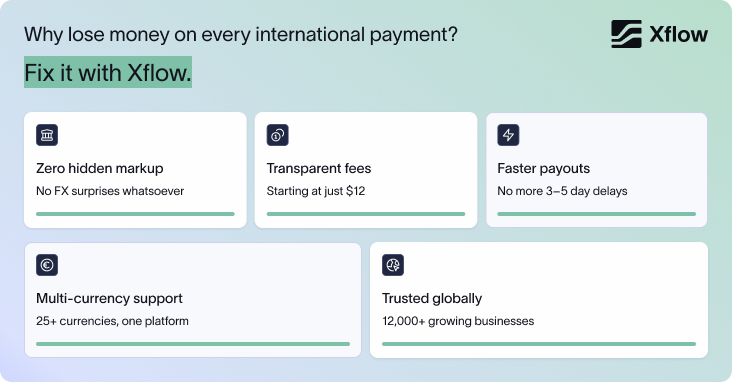
With Xflow, you can manage cross-border payments through a receiving accounts setup built for these compliance needs, stay aligned with regulatory requirements, and track transactions in real time, all without juggling multiple systems or manual processes.
So instead of treating compliance like a hurdle, you can build it into how your business runs every day.
That infrastructure is backed by independent audits, including how Xflow achieves SOC 2 and ISO compliance certification.
Frequently asked questions
Stablecoin compliance is what ensures the system actually works as expected. It covers who is using the stablecoin, how funds move, and whether the token is properly backed. Without these checks in place, it’s just value moving without control.
Because trust in stablecoins doesn’t come from the tech alone. It comes from knowing the asset is real, transactions are traceable, and misuse is controlled. Compliance is what makes stablecoins usable beyond just crypto, especially for payments and cross-border use.
There isn’t a single authority. Stablecoins have many applications, thus different regulatory bodies get involved. Bodies such as the Financial Action Task Force set AML standards, but entities such as the SEC or RBI will regulate finance. Sanctions implementation is by bodies such as OFAC.
At its most basic, you have to understand your users and their transactions. This involves identity verification upon sign-up and ongoing transaction monitoring. It’s not just about entry checks; it’s about ongoing visibility into activity.
Sanctions rules mean you can’t interact with restricted users or wallets. So issuers and platforms need to screen transactions in real time. If something is flagged, it may need to be blocked or even frozen. This applies not just to direct interactions, but indirect exposure as well.
It is the issuers that have the obligation to uphold the foundation of this process. The issuers are obliged to ensure that their liquid reserves are healthy; they must facilitate the redemptions smoothly, and they must be transparent on everything.
Exchanges act as a control layer. They authenticate users before granting access, keep an eye on transactions all the time, and notify if there is any unusual activity. They will also review the coins listed by them, and if anything does not comply, they may ban or delist it.
The impact is usually immediate. You can face financial penalties, restrictions on operations, or loss of banking support. In some cases, funds may be frozen. But beyond that, the bigger issue is loss of trust — which is much harder to recover.
This is where it gets complicated. Because laws differ from one country to another, platforms must adhere to international standards as well as local laws. There is no one-size-fits-all solution, hence the need for flexibility.
Yes, and at scale, it’s the only way it works. It helps monitor things in real time, detects risks, and screens sanctions. Technology records the transactions that are taking place accurately.
There can be penalties and fines. They will not be allowed to operate within their banking networks. In some extreme cases, the regulator may intervene.
Issuers are expected to regularly disclose what backs the stablecoin. This often includes reserve reports and independent attestations. The goal is to show that the circulating supply is fully supported and that the system is operating as claimed.
No. It really comes down to the kind of stablecoin that you hold, as well as where you reside. For example, the rules for fiat-backed stablecoins are more stringent than others.
The best strategy here would be compliance from the start. In other words, good onboarding, continuous monitoring, and partnering with compliant organizations. Addressing the problem once it arises is never easy.
Regulation in the stablecoin space will become clearer and more rigorous. You’ll see more defined licensing, tighter reserve requirements, and stronger oversight. Over time, stablecoins will be treated less like an emerging asset and more like core financial infrastructure.