Why one stablecoin now lives on many blockchains at once
Blockchain and stablecoins have become an important part of the modern global economy. Each year, they facilitate trillions of dollars in cross-border transactions. They also help support decentralised trading, global remittance, higher liquidity, accessibility, and more.
As the crypto market diversifies and grows, there has been an increase in the variety of stablecoins being used. In this guide, you'll learn what a multi-chain stablecoin is, how it differs from single-chain and cross-chain stablecoins, and how it enables interoperability across blockchains. You'll also discover the key benefits, risks, use cases in payments and DeFi, global regulatory frameworks, popular market examples, and best practices for businesses considering adoption.
Key Takeaways
- Multi-chain stablecoins help businesses transact across multiple blockchain networks without switching ecosystems, improving liquidity, reducing friction, and enabling faster cross-border settlements.
- They exist in three forms: natively issued on multiple chains (e.g., USDC on 30+ chains), wrapped/bridged (e.g., some USDT deployments), or a combination.
- Major market examples include Tether (USDT) on 10+ chains, Circle's USDC on 30+ chains, and Paxos's Global Dollar (USDG) on Ethereum, Ink, and Solana.
- Regulatory frameworks differ globally, MiCA in Europe, GENIUS Act in the US, Japan's Payment Services Act, and India's 30% VDA tax with 1% TDS.
- For Indian businesses, stablecoins aren't legal tender and carry heavy VDA taxation. Xflow offers FEMA-compliant cross-border payment infrastructure operating under final PA-CB authorisation from the RBI (as of February 2026) as a practical alternative.
What is a multi-chain stablecoin?
Multichain stablecoins are tokens typically issued natively on several blockchains at the same time, rather than existing on one chain and reaching the others only by bridging. For example, USDT (commonly referred to as Tether) exists on Solana, Tron, Liquid Network, Ethereum, and EOS simultaneously. This means it is a multichain stablecoin.
Stablecoins are digital tokens, similar to other cryptocurrencies and digital assets. However, unlike traditional cryptocurrencies, which are infamous for volatility, stablecoins are pegged to another asset (such as a fiat currency, like the US dollar). This design is meant to keep their value stable.
What is the difference between single-chain, cross-chain, and multi-chain stablecoins?
- Single-chain stablecoins are tokens that cannot move freely across different blockchains. They limit liquidity, complicate transactions, and can cause payment delays.
- Cross-chain stablecoins are those that can move freely across different networks. This could be due to bridging mechanisms, interoperability frameworks, burn-and-mint or lock-and-mint methods, and more.
- Multichain stablecoins exist across different blockchain networks. They can be natively issued on various chains, transferred to other chains or exist as a combination of both.
The distinction that matters is movement versus availability. Cross-chain is about moving one token between chains, so it depends on a bridge or a burn-and-mint mechanism at the moment of transfer. Multi-chain is about the same token already being available on several chains at once, so no transfer is needed to use it there. For the transfer mechanics themselves, see our cross chain stablecoin guide.
We take a closer look at how multi-chain stablecoins work below.
How do multi-chain stablecoins work?
Multi-chain stablecoins can exist in a few different ways, including:
- Natively issued coins: As the name suggests, these multi-chain tokens are directly deployed across multiple blockchains (such as Circle’s USDC, which is deployed on Solana, Ethereum, and Avalanche).
- Wrapped and bridged coins: These stablecoins are created on one blockchain and then transferred to another. This can be done with a cross-chain bridge or through interoperability protocols. Tether is an example of this.
Stablecoins can also be present on various chains through a combination of these factors. For example, a coin that is natively issued on multiple blockchains can also be bridged to others.
What are the benefits of multi-chain stablecoins?
Multi-chain stablecoins offer businesses, financial institutions, and users an array of benefits, including:
- Liquidity
One of the biggest benefits of multi-chain stablecoins is liquidity. Unlike single-chain stablecoins or traditional payment rails, market disruptions would have a lesser effect on multi-chain coins. Since they exist on many chains, if one faces disruptions or barriers, a different one can be utilized instead.
- Convenience
Multi-chain stablecoins are more convenient to use than those limited to a single network. Businesses can choose a blockchain that is best suited to their organizational requirements. This can help your organization achieve quicker transactions, better liquidity, lower fees, and reach consumers in previously inaccessible markets.
- A unified digital economy
Multi-chain stablecoins act as intermediaries between different blockchain networks. They help simplify transactions across different platforms, especially as organizations worldwide increasingly move away from traditional payment rails and adopt crypto-based payment methods.
What are the key use cases of multi-chain stablecoins in payments?
Multi-chain stablecoins have become a central part of how businesses conduct payments and cross-border transactions. Some use cases include:
- Cross-border transactions
Stablecoins allow businesses to send tokens directly to the recipient’s digital wallet instantly, regardless of the distance. Since there are no other banks or intermediaries, these transactions also incur minimal additional fees and aren’t subject to delays caused by banking hours, public holidays, or other traditional payment rail-related problems.
This means a business based in Singapore can make payments to its supplier in Paris almost instantly, rather than waiting hours or days for them to go through.
For the wider picture of how these rails are reshaping settlement, see our guide on cross border payments blockchain.
- Simplified payments
Another key benefit of using multi-chain stablecoins is the simplification of payments. Companies using stablecoins for payments do not need to worry about FX rate fluctuations or other associated charges. This means a US-based company can send a payment to a supplier in Germany within minutes, and the recipient can simply convert the amount to euros.
- DeFi
In DeFi, or decentralized finance, stablecoins are the main source of liquidity and act as the primary “currency.”
How do multi-chain stablecoins enable interoperability across blockchains?
In blockchain, interoperability refers to the ability to share data and communicate between different chains. It is the crypto equivalent of sending money (or other assets and data) from one bank to another.
This is a crucial concept for multi-chain stablecoins, allowing these technologies to actually work. Without interoperability, users would not be able to send value across networks, effectively rendering multi-chain stablecoins either useless or extremely complicated to use.
What are the security considerations and smart contract risks?
While multi-chain stablecoins have made cross-border transactions significantly easier, they also carry certain risks. These include:
Smart contracts
Smart contracts function like digital vaults, keeping stablecoin assets "locked" and secure. However, if there are any glitches, bugs, or security breaches, the stablecoin could lose its value entirely. To prevent this, stablecoin issuers and developers conduct regular audits and follow strict security protocols.
Bridge-related risks
Cross-chain bridges have been subject to numerous cyberattacks and hacking attempts, often involving hackers tricking the bridge into releasing assets on one chain without corresponding inputs on another. This can result in significant asset losses for users.
Liquidity risks
While cross-chain stablecoins are handy for global payments, spreading assets across different networks can thin out liquidity. This setup also creates a major risk: if a single chain encounters a security issue or bug, users could lose access to their funds entirely.
Regulatory Compliance
Since multi-chain stablecoins operate across networks and span different regions of the world, they are also subject to the regulatory requirements of each jurisdiction. It is crucial for issuers and businesses to be aware of these compliance requirements, as failure to adhere could result in significant penalties and charges.
What are some challenges in deploying multi-chain stablecoins?
Some of the major challenges associated with the deployment of multi-chain stablecoins include:
- Regulatory uncertainty: Because cryptocurrencies are a relatively new form of transaction, many jurisdictions are still determining how to regulate them. This can make it difficult for businesses to use them securely for transactions.
- De-pegging events: While stablecoins are designed to maintain a stable value, they are prone to de-pegging, or losing their peg to their underlying asset. (For example, in 2023, USDC, which is pegged to the US dollar, fell to $0.87 from $1). This can lead to financial losses for users.
- Interoperability challenges: One of the major challenges with stablecoins is interoperability across different blockchain networks. While many multi-chain coins exist, many blockchains still operate in isolation. This limits the user's ability to share value across chains, share data, and transact easily.
What are the regulatory and compliance considerations for multi-chain stablecoins?
Multi-chain stablecoins exist across multiple different chains and networks. This requires them to comply with a wide range of requirements that vary by region. Most require stablecoin issuers to undergo mandatory audits, report transactions transparently, conduct third-party audits, and more.
For example, in the US, the " Guiding and Establishing National Innovation for U.S. Stablecoins Act,” issued in 2025, requires issuers to provide monthly audit disclosures. The GENIUS Act also considers issuers as financial institutions under the Bank Secrecy Act.
In Europe, the Market in Crypto Assets (shortened to MiCA) regulations establish a comprehensive framework. Under MiCA, stablecoins are classified as e-tokens. The act also provides regulations surrounding consumer protection and stablecoin issuance.
Currently, India doesn’t have comprehensive regulations dedicated to stablecoins. For tax purposes, they fall within the perimeter of Virtual Digital Asset (VDA), which mandates a 30% charge on gains and a 1% TDS on transfers. However, they are not considered legal tender.
What are some popular multi-chain stablecoins in the market?
Some of the most popular multi-chain stablecoins in circulation include:
Tether
Also known as USDT, Tether was one of the first stablecoins issued and continues to be one of the most widely used. It exists across various blockchains, including Tron, Solana, Ethereum, EOS, Liquid, Tezos, and Statemint.
Circle
Circle’s USDC is also one of the most widely used stablecoins in the world. It is natively supported for 32 blockchain networks and continues to expand.
Global Dollar
Paxos’ USDG is a more recently launched stablecoin. It currently operates across Ethereum, Ink, and Solana, among others.
USDT and USDC are the two most often weighed against each other, and our usdt vs usdc guide breaks down where they differ.
How do multi-chain stablecoins compare to traditional payment systems?
For a head-to-head look at how these two rails differ on speed and cost, see our guide on stablecoin vs swift.
Below, we compare cross-chain stablecoin settlements with traditional cross-border transfers:
| Aspect | Traditional payment systems | Stablecoins |
|---|---|---|
| Time | Traditional methods take more time to settle payments. This can range from a few hours to sometimes multiple days or weeks. | Stablecoin transactions can be settled almost instantly, with most completed within a few minutes. |
| Accessibility | Accessibility can be limited in traditional payment methods, since they rely on banks and financial institutions. In areas where banking is unavailable or during public holidays and weekends, payments often stall. | The blockchain can be accessed 24/7, making stablecoins more accessible. Multi-chain stablecoins in particular are more accessible than others, since users do not need to switch networks to use them. |
What are the best practices for businesses and investors?
Multi-chain stablecoins are prone to several risks. Businesses can implement certain best practices to protect themselves from financial losses or security breaches. These include:
- Research: One of the best ways to ensure your business is protected is to conduct thorough research regarding stablecoins. The issuer you choose is important- do they adhere to local regulations? Do they provide transparent records and reserve compositions? Choosing issuers that undergo regular audits, maintain transparent records, and receive good third-party reviews can help you choose a secure stablecoin.
- Training and incident response planning: It is also crucial that teams across your organization understand how to use stablecoins and what to do in the event of challenges (such as depegging, security breaches, or bugs). Having a fixed protocol to follow can help your organization minimize losses.
- Minimize multichain complexities: To ensure your clients can enjoy a smooth and streamlined payment process, its crurical to reduce multichain complexities as far as possible. This includes clearly displaying fees, auto-selecting the best payment route, and more.
What is the future outlook of multi-chain stablecoins?
Today, stablecoins are becoming the backbone of international blockchain payments, with multiple businesses and institutions adopting them as transaction mediums.
As digital finance becomes the norm, multi-chain stablecoins will serve as the enablers of seamless transactions, high liquidity, and interoperability.
Conclusion
In India, blockchain payments and stablecoins are still not properly regulated or recognized as legal tender. This makes it extremely difficult for businesses to use it for international transactions.
Luckily, this is where Xflow comes in. Our platform allows businesses in India to expand their operations across the globe, with secure, regulatory-aligned infrastructure that allows them to receive payments in a compliant and reliable way.
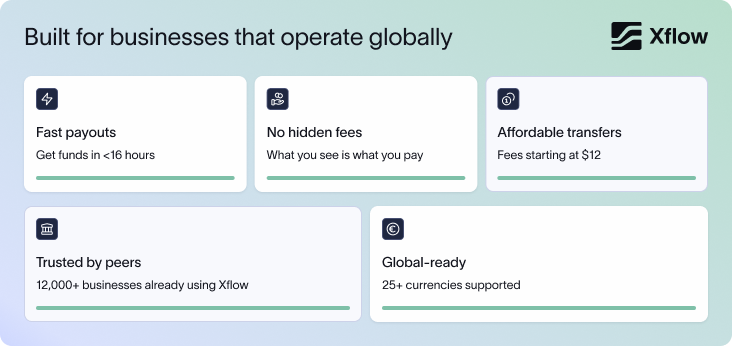
Xflow offers transparent pricing, multi-currency transactions, next-day settlements, AI-powered FX insights, and countless other features and benefits.
Its receiving accounts give Indian businesses one dedicated account to receive that international revenue, stablecoin-settled or not, without touching the regulatory grey area directly.
Start receiving your international payments with Xflow
Frequently asked questions
Stablecoins are digital tokens designed to maintain a peg to a pegged asset, such as the US Dollar. Multi-chain stablecoins can operate natively across various blockchains, leveraging the unique advantages of each network.
Multichain stablecoins are tokens that can exist independently across multiple blockchains. In contrast, cross-chain transfers can move from one blockchain to another using different methods (such as burn-and-mint).
Multi-chain stablecoins' advantages include:
- Lower costs for international transitions
- Quick transitions 24/7
- Improved liquidity of assets
- Higher interoperability in digital finance
- Flexibility and efficiency
Some stablecoins are issued natively across multiple blockchain networks. Others use bridges to operate freely across them. Some multi-chain stablecoins may even use a combination of both these methods to operate across chains.
Compared to single-chain stablecoins, multi-chain tokens do come with increased risks. This is because they operate across multiple networks and are prone to smart contract risks, liquidity challenges, and other issues.
Some of the main challenges associated with multi-chain stablecoins include:
- Bridge mechanism-related security risks
- Liquidity challenges
- Custodial risks
- Regulatory risks
Yes, businesses can use multi-chain stablecoins to conduct transactions, whether within the same region or across borders. These payments are generally faster and less costly.
DeFi applications benefit from multi-chain stablecoins, as they facilitate seamless transactions, reduce liquidity issues (compared to single-chain coins), save time and transaction costs, and more.
While many regions have regulatory frameworks for crypto-related currencies, regulations are still evolving as the crypto market grows.
Stablecoins such as USDC, Tether (USDT), Global Dollar, and more operate across multiple blockchains.
Multi-chain stablecoin transactions are significantly faster than traditional payment methods. They can be settled within minutes, even if payments are made across the globe, since they do not rely on multiple intermediaries and banks.
The cost of multi-chain stablecoin transactions is significantly lower than fees charged by traditional banks and financial institutions. The amount varies based on the blockchain, issuer, processing fees, and other factors.
Unlike traditional fiat payments, multi-chain stablecoin payments can be settled instantly. Or within a few minutes. The network is accessible 24/7, 365 days a year, and the process does not rely on banks. Due to fewer intermediaries, the associated costs are also significantly lower.
Multi-chain stablecoin systems require strict protocols to protect them from security breaches, hackers, and other risks. Some protocols include regular thorough audits, real-time monitoring, transparent reporting, and more.
Over the past 5 to 6 years, stablecoin supply has grown from $5 billion to $305 billion and continues to be more widely used. Multi-chain stablecoins will serve as the foundation for seamless transactions across blockchains and borders.