Introduction
Cross-border payments have an uncomfortable variable built into them: the exchange rate. Between the moment a deal is agreed and the moment money actually settles, the rate can move quite a lot. Sometimes marginally, sometimes to an extent you can’t ignore.
For businesses managing international transactions on a regular basis, that unpredictability adds up. Guaranteed rates are one way to take that variable off the table.
In this guide, you'll learn what a guaranteed rate is, how it works in foreign exchange transactions, and how it differs from spot and forward rates. You'll also discover when to use guaranteed rates, their benefits, risks, actual cost, and RBI regulatory considerations, plus best practices to get the most value out of rate locks for cross-border payments.
Key Takeaways
- Guaranteed rates help businesses remove FX uncertainty from active cross-border transactions by locking in an exchange rate for a defined window (typically minutes to 72 hours), protecting margins and cash flow predictability.
- Unlike forward contracts, guaranteed rates are designed for transactions already in motion - not long-term hedging of future FX exposure.
- The platform's margin is baked into the rate itself; there's no separate fee, but the spread against the mid-market rate is effectively your cost.
- In India, guaranteed rates must be offered by RBI-authorised AD banks or licensed fintech platforms under FEMA guidelines.
- Platforms like Xflow offer transparent mid-market-linked pricing with no hidden FX markup, giving businesses clear visibility into what they're paying.
What is a guaranteed rate?
Guaranteed rate is mostly used in the context of foreign exchange transactions. It’s a rate that a payment provider, bank, or a forex platform offers to lock in for you at the moment of your transaction, protecting you from market fluctuations for a specified window of time. All through that period of time, you’re given the assurance that if you proceed with the transfer or conversion, you'll get exactly that rate.
How does a guaranteed rate work?
When you initiate a transaction, either for sending money abroad or completing a cross-border purchase, the platform you’re doing that with locks in an exchange rate for you at that moment. This locked rate stays valid for a set window of time, which can be anywhere from a few minutes (for a retail transfer) to up to 72 hours (for business transactions). Within that window, it doesn't matter how the currency market moves. You convert at exactly the rate you were shown.
The whole point is to remove uncertainty from the middle of a transaction. Without it, there's always a gap between the moment you see a rate and the moment your money actually arrives. And in volatile markets, that gap can cost you a lot.
A few things worth knowing about how the window works:
- Your rate activates once the full payment amount reaches the platform, not when you initiate the transfer.
- Weekends typically don't count toward the validity window, since banks don't process payments on those days.
- If you miss the window, the platform simply uses the live market rate at the time your money arrives. Your transfer still goes through, just at a different rate.
- In extreme cases, if the market moves very sharply (say 5% or more) during your lock period, the platform may cancel and refund the transfer rather than take a large loss on the rate.
One more thing to be mindful of is that the guaranteed rate is fixed in both directions. If the market moves in your favour after you've locked in, you don't benefit from it. The lock protects you from the downside, but the upside goes to the platform. That's the trade-off, and it's by design.
How does a guaranteed rate differ from a spot rate?
A spot rate is the live market exchange rate at any given moment that reflects what a currency is worth right now and moves constantly as markets fluctuate. When you transact at a spot rate, you get whatever the market is offering at that exact instant, with no lock or protection.
A guaranteed foreign exchange rate starts from the spot rate but takes it a step further. The platform fixes it for a defined window so you're not exposed to movement during your transaction cycle. It’s more like a spot rate with a short-term stability layer on top. The rate you see is still derived from current market conditions, but it won't change on you while you're in the middle of completing the transaction.
If you would rather choose your own rate instead of accepting the spot, our limit order vs spot conversion comparison sets out the trade-off.
How does a guaranteed rate differ from a forward rate?
A forward rate is an exchange rate that’s pre-agreed for a transaction that settles at a future date. It could be anywhere from a few days to several months. It's priced using the current spot rate adjusted for the interest rate differential between the two currencies over that period, which means it's a market-derived rate, not just a locked snapshot.
A guaranteed rate, by contrast, is fixed for a short validity window and is designed for transactions that are already in motion, not ones being planned for the future. It's also not up for negotiation and is non-discretionary. Plus, there's no adjustment for interest differentials or tenor, as is the case with the FX forward rate.
To put it clearly, a forward rate is a hedging instrument that helps with future FX exposure. And a guaranteed rate is used to stabilize pricing within an active transaction cycle.
If you are weighing those two instruments directly, our spot rate vs forward rate comparison breaks down when each applies.
When to use a guaranteed rate?
Guaranteed rates come in handy the most when you need cost certainty for a specific cross-border transaction that's already in motion or coming up shortly, such as:
- Paying overseas suppliers: If you're an importer or a services provider with a payment due to your foreign client, locking the rate gives the assurance that the final amount you pay won't shift between now and when the payment settles.
- Running international payroll: Companies that pay employees or contractors abroad can fix the conversion rate upfront, making salary costs predictable month to month.
- Managing export or import transactions: Exporters use it to lock in the value of incoming foreign currency, while importers use it to have some control over their procurement costs.
- Repaying foreign currency debt: If your business has loans denominated in a foreign currency, a guaranteed rate removes the risk of your repayment amount growing due to unfavorable rate movement.
What are the benefits of guaranteed rates?
Currency markets don't pause for your payment cycle. A rate that looks favourable when you initiate a transaction can look very different by the time it settles. And if dealing in large cross-border volumes is business as usual for you, you know that even a 0.5% move can translate into a meaningful cost difference. Guaranteed rates exist precisely to eliminate that variable. The help with:
- Cost predictability: You know exactly how much a transaction will cost in your home currency before it executes, which makes budgeting and financial planning considerably more reliable
- Reduced FX exposure: For the duration of the lock window, your transaction is completely insulated from market volatility, no matter how the currency pair moves
- Cleaner cash flow management: When your conversion costs are fixed, it's easier to match outflows to expectations, especially for recurring payments like payroll or supplier settlements
- Faster decision-making: Teams don't need to time the market or wait for a better rate before approving a payment; the rate in front of them is the rate they'll get
- Operational simplicity: Compared to more complex hedging instruments like options or forwards, guaranteed rates require no financial expertise to use; the platform handles everything
What are the risks and limitations of guaranteed rates?
Guaranteed rates solve for one specific problem: rate certainty during a transaction window. But that narrow focus also means they come with trade-offs that are easy to overlook, like:
- No upside participation: Once you lock a rate, you're committed to it. If the market shifts in your favour after the lock, you can’t benefit from it.
- Short validity windows: For most retail and SME use cases, the lock window is measured in hours, not days. If you’re not able to settle the payment within that window, the rate expires, and you're back to whatever the market is offering at that moment.
- Extreme volatility can void the guarantee: In cases of sharp, sudden market moves, some platforms reserve the right to cancel the transaction and refund you rather than honor the locked rate.
- Creates rigidity in payment timing: Because the lock window is fixed, it can add pressure to complete payments quickly, which doesn't always align with how bank transfers or internal approvals actually work.
What is the impact of guaranteed rates on importers and exporters?
An importer who has made a budget for a purchase at one rate but has to settle at another has paid more for the same goods. An exporter expecting a certain INR value from a USD invoice can end up with less the moment the rupee strengthens. Guaranteed rates address this in different but equally meaningful ways for each side.
- Importers get cost certainty at the point of commitment: When a purchase order goes out, the importer already knows their liability in home currency. There's no guessing what the final landed cost will be by the time the invoice is due.
- Exporters protect their receivables: Locking a rate on an expected foreign currency payment means the converted value is fixed. Now, it doesn’t matter how the exchange rate moves between shipment and settlement.
- Margin protection becomes more reliable: Both importers and exporters price their deals with certain FX assumptions. A guaranteed rate ensures those assumptions hold through to settlement, keeping margins intact.
What does a guaranteed rate actually cost?
Unlike forward contracts or forex options, there's no separate fee or signed agreement when you use a guaranteed rate. The cost is simpler than that, and also easier to overlook because of it.
When a platform quotes you a guaranteed rate, that rate already has the platform's margin built into it. The difference between the raw interbank rate and the rate you're offered is effectively what you're paying for the lock. You won't see it as a line item, which is why many businesses don't actively think of it as a cost at all.
A few things worth knowing:
- The spread varies by platform: Banks typically carry a wider margin than fintech platforms, meaning the same transaction can have meaningfully different effective costs depending on where you execute it.
- It also varies by currency pair: Major pairs like USD/EUR or USD/INR tend to have tighter spreads than exotic or less liquid currency pairs, where platforms price in more risk.
- Longer lock windows can cost more: For platforms that offer extended validity periods, the margin on the rate may be slightly wider to compensate for the increased market risk the platform is absorbing.
What are the regulatory considerations for guaranteed rates in India?
The guidelines applied to any forex transactions in India also cover transactions that come with guaranteed forex rates. And such transactions are governed by the RBI and the Foreign Exchange Management Act. These guidelines cover:
- Authorized Dealer requirement: In India, forex transactions can only be executed through RBI-authorized dealers. Typically, banks and licensed fintech platforms. This matters because not every platform offering a guaranteed rate is necessarily authorized to do so in India. You need to verify the platform's AD (Authorized Dealer) license status before using it.
- Documentation requirements: RBI requires underlying documentation for cross-border transactions, like a purchase order, invoice, or contract that justifies the forex transaction. You can't lock a rate speculatively without a legitimate underlying trade transaction to back it up.
- Repatriation rules: For exporters specifically, the RBI has rules around how long foreign currency receipts can be held before they must be converted and repatriated. This directly interacts with how long a rate lock can practically be held.
What are common mistakes to avoid when using guaranteed rates?
Guaranteed rates are operationally simple. But sometimes that simplicity can create a false sense that there's nothing to get wrong. As a matter of fact, here are some mistakes that are easy to overlook:
- Locking too early or too late. Businesses often lock at the wrong point in the transaction cycle, either before payment details are confirmed or after the favourable window has passed.
- Using guaranteed rates for long-horizon payments. Usually, to stretch a short-window tool beyond what it's designed for, then getting caught when the lock expires.
- Locking the wrong amount. If the payment amount changes after the lock, the guarantee may not apply cleanly to the revised figure.
- Over-relying on guaranteed rates as a complete FX strategy. Using them for every single cross-border payment without evaluating whether a forward or another instrument would be more cost-effective for certain transaction types.
- Locking a rate without confirming the payment method. Different payment rails (SWIFT, local transfer, etc.) have different settlement speeds. Locking a rate without knowing how your payment will move can mean the money might arrive after the window closes.
What are the best practices to get the most out of guaranteed rates?
Used well, a guaranteed rate removes FX uncertainty from the equation entirely. Here’s how you can do it:
- Lock at the point of invoice confirmation. That's when the amount and timeline are both known with certainty.
- Always check the validity window against your actual payment timeline before locking. Make sure your bank transfer can realistically settle within the window.
- Compare the guaranteed rate against the mid-market rate before accepting. Understanding the spread helps you evaluate whether the platform's pricing is reasonable.
- Build FX lock timing into your payment workflow. Treat it as a step in the process.
- For payments that fall outside typical guaranteed rate windows, evaluate whether a forward contract is more appropriate rather than forcing a short-term tool to do a long-term job.
- Consider an fx limit order when you want to target a specific rate rather than simply lock the current one.
Conclusion
Guaranteed rates don't eliminate FX risk entirely, but they remove it precisely where it matters most: during an active transaction. Used at the right point in your payment cycle, with the right amount and the right payment method lined up, they bring a level of predictability to cross-border payments that's hard to achieve otherwise. The key is understanding what they're designed for, where they fall short, and how they fit alongside other instruments in your broader FX strategy.
For Indian businesses that manage cross-border payments, having the right platform underneath all of this matters just as much as understanding the concepts. That's where Xflow comes in.
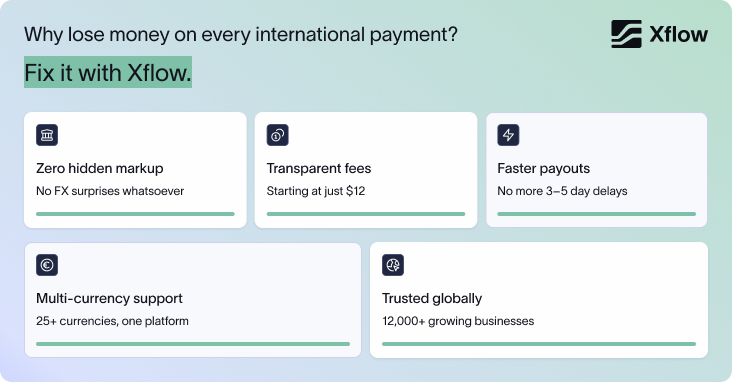
Xflow is a cross-border payments platform built specifically for Indian businesses of all sizes that need to receive money globally without the opacity and cost of traditional banking. A few things that set it apart include:
- no markup on the mid-market rate
- Next business day settlement
- Multi currency accounts
- Transparent pricing with no hidden fees
- Up to 50% savings on transfer fees
- Unlimited transactions
- FX AI analysts
- Business-ready solutions
If your business deals in cross-border payments and you're still absorbing unnecessary FX costs, it's worth seeing what Xflow can do.
Better rate. Better platform. Better choice.
Frequently asked questions
A guaranteed rate is an exchange rate that a platform locks in for you for a set period of time, protecting you from market movement while your transaction is in progress.
When you initiate a transfer, the platform fixes the rate for a validity window. If your payment arrives within that window, you convert at exactly that rate with any changes.
A spot rate is live and changes constantly. A guaranteed rate is derived from the spot rate but frozen for a short window, giving you stability during an active transaction.
A forward rate locks in a rate for a future transaction, weeks or months later. A guaranteed rate is for transactions already in motion, with a window of hours to days.
Banks, fintech platforms, and cross-border payment providers typically offer guaranteed rates. The window length and pricing vary by provider, so it's worth comparing before committing to one.
Yes, for the duration of the validity window, it's completely fixed. The market can move in either direction, and your rate won't change, as long as the payment arrives within that window.
It removes FX uncertainty from your transaction, makes costs predictable, protects your margins, and simplifies budgeting, without needing any expertise in forex markets or hedging instruments.
There's no separate fee usually. The platform's margin is already baked into the rate itself. The gap between the mid-market rate and your quoted rate is effectively what you're paying.
When a transaction is already in motion, and you need cost certainty like when paying a supplier, settling an invoice, or running international payroll. It's a tool for active transactions, not future planning.
Yes. Exporters can lock a rate on expected foreign currency receivables, protecting the converted value from market movement between when the deal is agreed and when payment actually settles
If the market moves in your favour after locking, you don't benefit. The window can also expire before payment settles. And in extreme volatility, the platform may cancel rather than honor the rate.
Once confirmed, yes, the platform is committed to honoring it within the validity window. However, most providers include a clause allowing cancellation in cases of extreme market movement.
It depends on the platform and use case. Retail transfers typically lock for minutes to hours. Business-focused platforms can offer windows up to 72 hours. Always check before initiating a transaction.
Retail platforms offer guaranteed rates to individual users during transfers. The window is short, usually enough to complete the transaction, but the protection is the same.
Use spot rate for immediate conversions where timing is flexible. Use guaranteed rates for active transactions needing short-term certainty. Use forwards when you're planning payments weeks or months ahead.