Introduction
Stablecoins promise something simple: digital money that doesn’t fluctuate.
And for the most part, they deliver. In fact, they processed over $27 trillion in transactions in 2024 alone.
But once you look past the “stable” part, a more interesting question shows up - what’s actually keeping them stable?
Because behind every stablecoin is a system. And depending on how that system is built, the difference can be huge.
And that difference? It’s what separates compliant stablecoins from the rest.
In this guide, you'll learn what a compliant stablecoin is, how it differs from regular stablecoins, and which regulatory standards it must meet. You'll also discover the key compliance features (KYC, AML, OFAC, audits), the roles of issuers and operators, cross-border challenges, risk management, benefits, real-world case studies, and best practices for adoption.
Key Takeaways
- Compliant stablecoins help businesses, banks, and users transact digitally with confidence — combining the speed of blockchain with the transparency, reserve backing, and regulatory oversight of traditional finance.
- Core compliance features: KYC (identity), AML (transaction monitoring), OFAC screening (sanctions), 1:1 reserve backing with independent audits, and clear redemption rights.
- Major examples include Circle's USDC (compliant, audited, widely accepted), while TerraUSD (UST) represents how algorithmic non-compliant stablecoins can catastrophically fail.
- Regulatory frameworks include the US GENIUS Act (2025), EU MiCA (2024 enforcement), plus Singapore, Hong Kong, and UAE licensing regimes.
- For Indian businesses: stablecoins aren't legal tender in India and face a 30% VDA tax + 1% TDS. Xflow's RBI-approved, FEMA-compliant payment infrastructure offers a regulated alternative.
What is a compliant stablecoin?
A compliant stablecoin is simply an electronic version of money which remains pegged to a fiat currency, such as the United States dollar or the euro.
However, what sets it apart from others is the fact that it does not exist in the gray zone. It’s built to follow regulations and is usually monitored by financial authorities.
If you’ve come across stablecoins earlier, some of them relied on complex algorithms or didn’t clearly show how they were backed. Compliant stablecoins take a different approach; they should comply with set legal standards, such as those set by MiCA in Europe or the recently introduced laws in America, such as the GENIUS Act.
In other words, apart from maintaining the stable price level, there is another crucial aspect involved: transparency and reliability.
How do regular and compliant stablecoins differ?
All stablecoins are not created equal, especially when it comes to how you intend to use them.
Let’s break it down briefly:
Regulation
Regular stablecoins may operate with little to no regulatory oversight. Compliant stablecoins are designed to follow financial regulations.
User verification
Regular stablecoins often allow anonymous or pseudonymous use. Compliant stablecoins require identity verification (KYC).
Transparency
Regular stablecoins may not clearly disclose reserve backing. Compliant stablecoins provide regular audits and transparency reports.
Transaction monitoring
Regular stablecoins have limited monitoring. Compliant stablecoins actively monitor transactions for suspicious activity.
Adoption
Regular stablecoins are widely used in crypto-native environments. Compliant stablecoins are more suitable for businesses, banks, and institutions.
Here’s a tabular comparison as well:
| Feature | Regular stablecoins | Compliant stablecoins |
|---|---|---|
| Regulation | Minimal or none | Operate under regulatory frameworks |
| User identity | Often anonymous | KYC required |
| Transparency | Limited or unclear | Audited and transparent |
| Transaction monitoring | Basic or none | Continuous monitoring (AML checks) |
| Risk level | Higher | Lower due to oversight |
| Institutional use | Limited | High suitability |
What regulatory standards apply to compliant stablecoins?
If you’re asking yourself what exactly “compliance” means, it’s simple: compliance is when you satisfy a certain set of standards for regulatory requirements that aim at increasing the stability of stablecoins.
In terms of the definition provided by the US Securities and Exchange Commission (SEC), the term compliant stablecoin does not imply only having intrinsic value; rather, such coins have specific structural properties designed to ensure user safety.
Here’s what that looks like in practice:
1:1 reserve backing
Stablecoins are to be fully supported by quality and liquid assets, so you'll always be able to redeem them for their full face value.
Clear redemption rights
There should be no restrictions when converting stablecoins to fiat money.
High-quality reserves
The reserves must be kept in safe and liquid financial assets like cash and treasury bonds, never volatile or speculative assets.
Transparency and disclosures
Stablecoin issuers are supposed to provide information about the composition of their reserves and the risk factors behind the coins.
Regulatory oversight of issuers
Only regulated and competent entities should act as stablecoin issuers.
Risk management and consumer protection
Risk management in stablecoin systems focuses on dealing with situations where the system faces operational, liquidity or market stress problems.
What are the key compliance features of stablecoins?
A stablecoin that is deemed as “compliant” will generally involve several key systems operating behind the scenes to maintain security and accountability. These include the following:
KYC (Know Your Customer)
You will first have to go through the process of identification or verification before you can even access any compliant stablecoin services.
While the step itself may seem redundant to some, its implementation is necessary to know the person engaging in the transactions.
AML (Anti-Money Laundering)
Once you’re in, transactions don’t just move unchecked. AML solutions keep track of the user activity at all times, searching for any abnormalities, including large-scale transfers and other anomalies.
When something seems odd, it is automatically flagged for further examination. This mechanism prevents various types of criminal activity, such as money laundering, in the blockchain-based payment network.
OFAC and sanctions screening
Compliant stablecoins also screen users and transactions against global sanctions lists (like those maintained by authorities such as OFAC).
This makes sure that no money will go to any restricted person, organization, or region. This is an important part of making sure that the system remains in accordance with international laws.
Audits and transparency
This is where trust really comes into play.
Compliant stablecoins are expected to undergo regular audits to confirm that they’re actually backed by reserves, just as they claim. These reserves are usually held in cash or cash-equivalent assets.
On top of that, issuers publish transparency reports that give you a clear picture of how funds are managed. So instead of taking their word for it, you can actually see what’s backing the value.
What roles do issuers and operators play in compliance?
Compliance is a dynamic process which changes over time, and each stakeholder is involved in different aspects:
Issuers (The creators)
Issuers are individuals or organizations that issue the stablecoin. Their role is much more than simply creating the stablecoin token. They need to:
- The stable coin is backed 1:1 with the reserve.
- There is transparency in the form of reporting.
- Redemptions are facilitated in case users want to exchange it for fiat currency.
- The regulation requirements are met.
The issuer is responsible for creating a credible coin.
Operators (The enablers)
Operators are the platforms and networks that handle how the stablecoin is actually used, think exchanges, wallets, and payment providers.
They’re responsible for:
- Verifying users through KYC processes.
- Monitoring transactions for suspicious activity (AML).
- Enforcing sanctions screening.
- Maintaining systems that keep everything compliant in real time.
So while issuers build the foundation, operators make sure everything runs safely on a day-to-day basis.
How do exchanges and payment networks ensure compliance?
If issuers build the stablecoin, exchanges and payment networks are where most of the action actually happens. It is up to them to ensure that all transactions conducted within the network conform to the set regulations.
Many of these checks run through a dedicated crypto payment gateway built to screen and monitor stablecoin transactions end to end.
Below is how they ensure compliance:
Onboarding and verification of users
Before any user can engage in buying, selling, or transferring their stablecoins, most exchanges will require the users to be verified.
This entails conducting KYC checks such as verifying the users’ identities and assessing their risks.
Transaction monitoring
Once you’re in, your transactions are continuously monitored.
Platforms use compliance tools to:
- Track transaction patterns
- Flag unusual activity (like large or rapid transfers)
- High-risk wallets identification
This is important in order to detect any suspicious activity at an early stage.
Sanctions and compliance monitoring
The exchange or payment network filters out any user or address on the blacklists of sanctions imposed worldwide.
If there are any transactions made by the restricted individuals or organizations, they will be stopped immediately.
Record-keeping and reporting
Such platforms have to keep track of all activities as well as report any suspicious activity to the regulator if necessary.
It is vital for institutions since this creates transparency and leaves the audit trail.
Link to financial systems
Another feature of the compliant exchanges and payment networks is their link to traditional financial systems and banks.
That means that more stringent standards should apply to ensure smooth transactions within different environments.
What are the cross-border regulatory considerations for compliant stablecoins?
Stablecoins are built for global use. You can send value across countries in seconds. However, the problem is that not all regulations have the same pace or even the same regulations.
And this makes things a little difficult when stablecoins are used across different countries.
Different rules in different countries
Each country has its own approach to crypto and stablecoins.
- Some regions have clear frameworks (like Europe’s MiCA).
- Others are still developing regulations.
- A few have strict restrictions or partial bans.
This means a transaction that’s perfectly fine in one country might raise compliance issues in another.
Conflicting compliance requirements
Now imagine trying to follow multiple rulebooks at once.
- One country may require strict KYC checks.
- Another may have different AML thresholds.
- Reporting requirements can vary widely.
For businesses operating globally, this can create friction and extra compliance work.
Jurisdictional uncertainty
As soon as the transaction becomes international, the matter becomes complicated - is it the jurisdiction of the sender, receiver, or platform that applies? In most instances, it might involve all three jurisdictions.
This complexity makes compliance even more difficult for platforms handling high transaction volumes.
Sanctions and restricted regions
Cross-border payments must also adhere to international sanctions. These include:
- Screening users and wallets globally.
- Blocking transactions linked to restricted regions.
- Continuously updating compliance systems as rules change.
One missed check here can lead to serious regulatory consequences.
Currency and capital controls
Some countries have regulations governing financial transactions in or out of the country.
A stablecoin transaction may be technically feasible; however, it may also be subject to regulations depending on the country’s financial laws.
What does this mean for you
If you’re using stablecoins, you might not notice these complexities. But for businesses handling cross-border payments, this is where compliance becomes critical.
It’s not just about sending funds, it’s about making sure those funds can legally and smoothly move across different regulatory environments without hitting roadblocks.
For the India-specific angle, our guide on stablecoin b 2 b payments india offramp compliance covers off-ramp rules in detail.
How do compliant stablecoins manage risk and prevent fraud?
When you’re dealing with money, digital or not, risk is always part of the picture. The difference with compliant stablecoins is that they’re built to actively manage that risk instead of reacting after something goes wrong.
This is how it works:
Real-time transaction monitoring
Transactions are monitored as they occur in real time.
Suspicious behavior includes transactions with abnormally high amounts of money involved or any transactions made at an unusually fast rate. If it seems unusual, it will be reported immediately.
Risk scoring systems
Not all users or transactions have the same risk levels.
That is why risk scoring is done depending on the following parameters:
- Transaction size and frequency
- Geographic location
- Past behavior
Transactions with higher risk levels are subjected to more scrutiny, whereas, low-risk transactions face fewer obstacles.
Fraud detection tools
Sophisticated software tools, utilizing artificial intelligence and blockchain analytics, are used to detect anomalies in user behavior.
These systems can:
- Trace the movement of funds across wallets.
- Detect patterns linked to fraud or scams.
- Discover links between an individual address and high-risk wallets.
Rather than waiting for the fraud to occur, it is detected at an early stage.
Alerts and escalation mechanisms
If anything looks out of place, it does not remain unnoticed.
- Alerts are triggered automatically
- Transactions may be paused or reviewed
- Compliance teams step in if needed
This layered response helps contain risks quickly.
Continuous compliance checks
Risk management isn’t a one-time thing.
Systems keep updating as:
- Regulations change.
- New fraud patterns emerge.
- Sanctions lists are updated.
This allows the system to remain adaptive and resilient.
What are the benefits of using compliant stablecoins?
Now that you know all this, you may ask yourself - is it worth it? In most cases, it's actually better for you. Why? Let's find out.
More trust and credibility
Since they comply with regulations and are transparent in their actions, stablecoins earn more trust and credibility. There is always something to support your claims.
Safer transactions
As they conduct KYC, AML, and employ transaction monitoring tools, fraud risks are minimized.
In other words, you can send money with less worry, particularly large or regular payments.
Easier integration with banks
Compliant stablecoins are more likely to work smoothly with traditional financial systems.
Banks and payment providers are far more comfortable dealing with assets that meet regulatory standards.
Reduced regulatory risk
This point cannot be overlooked by any business.
Using compliant stablecoins ensures that there will be no legal hassles, fines, or unexpected disruptions due to regulatory issues.
Better for cross-border payments
Since they’re built with compliance in mind, these stablecoins are better suited for international transactions.
They are less complicated than other methods when it comes to handling more than one regulatory environment.
Institutional adoption
Big companies and financial technology platforms are in favour of using systems which comply with regulations.
Therefore, if your goal is long-term success, you should consider working with compliant stablecoins.
Auditing and transparency
Being audited regularly means that you always know what is happening with your money.
This transparency helps build trust in transactions.
In simple terms, compliant stablecoins trade a bit of flexibility for something much more valuable: reliability.
And if you’re thinking beyond casual use, whether it’s business payments, global transfers, or scaling operations, that reliability can make all the difference.
What do case studies of compliant vs non-compliant stablecoins reveal?
Often, the best method of comparison is to examine the actual outcomes. We will examine two cases that illustrate their distinctions:
Case 1: A compliant stablecoin in action
Take USD Coin as an example.
USDC is a stablecoin created by Circle and works within regulatory structures. What does this mean in practice?
- Reserves are regularly disclosed and independently attested.
- Users go through KYC when accessing it via regulated platforms.
- It’s widely accepted by banks, fintechs, and payment providers.
- It’s used in real-world applications like cross-border payments and settlements.
As a result, USDC enjoys a good reputation and is widely used by financial institutions.
Case 2: A non-compliant stablecoin collapse
Now let’s take TerraUSD.
Notably, unlike other forms of compliant stablecoins, TerraUSD was not backed by any type of reserve but had an algorithmic system instead.
What followed:
- The stablecoin lost its value rapidly.
- Billions of dollars were wiped out.
- There was little regulatory protection or recovery mechanism.
- It triggered wider market instability.
It was one of the most controversial instances involving a stablecoin in crypto.
What these cases show
When compared, it becomes evident that:
- Stablecoins that comply with regulations prioritize transparency and reserve requirements.
- On the other hand, non-compliance might lead to the use of less sustainable mechanisms.
For you as a user, or especially if you’re a business, the takeaway is simple:
Stability isn’t just about maintaining a price. The essence of this is the availability of systems that can cope with unpredictable situations.
What are the challenges in maintaining stablecoin compliance?
By now, compliant stablecoins might sound like the safer, smarter choice - and they are. However, keeping such a high level of compliance is not an easy task. A lot goes on backstage to ensure ongoing stablecoin compliance.
Some of the main challenges include:
Changing regulations
Regulations for stablecoins are dynamic.
Compliant today, but come tomorrow, when fresh demands arise, your platform will have to adapt to those changes to avoid non-compliance.
Such compliance will definitely cause problems for a smaller business.
High operational costs
Compliance isn’t cheap.
Investing in KYC systems, transaction monitoring, auditing, and reporting is expensive.
For small organizations, this poses a considerable challenge.
Balancing privacy and compliance
Privacy matters to users, whereas transparency matters to regulators.
Finding the perfect balance can be tough in an environment where privacy was of utmost concern from the get-go.
Cross-border challenges
Global operations increase complexity even further.
Every nation has its own set of regulations, some of which may even clash with each other.
Real-time monitoring on a massive scale
Stablecoin networks handle large volumes of transactions every day.
Keeping track of all that activity in real time, while still catching risks accurately and not slowing things down, is a tough balance to get right.
Evolving fraud tactics
When the methods become more advanced, people tend to develop new techniques to overcome them.
Since fraud methods change all the time, detection methods also have to continuously evolve accordingly.
Maintaining transparency and trust
Audit and disclosure are assumed, but not without their demands.
Any delays or gaps in reporting can quickly raise concerns and affect trust.
What technology solutions support stablecoin compliance?
Maintaining compliance for a stablecoin may seem complicated at first glance, but the technology handles it in the background. The idea is to achieve compliance in the easiest way.
This is how it is achieved:
Automated KYC solutions
Instead of conducting manual checks, platforms adopt digital KYC systems which can:
- Verify identity documents in seconds.
- Run facial recognition checks.
- Flag high-risk users automatically.
This way the process of verification becomes faster.
Blockchain analytics software
Because transactions within stablecoins take place using blockchain technology,
Analytics tools help platforms:
- Track movement of funds across wallets.
- Identify potentially fraudulent or high-risk address.
- Spot trends associated with fraud or criminal activity.
Think of it as an ongoing surveillance of the flow of money.
Fraud detection through AI and ML algorithms
Artificial intelligence and machine learning algorithms are widely used to detect any abnormal behavior.
They can:
- Learn normal transaction patterns.
- Detect anomalies instantly.
- Decrease unnecessary alerts and false positives.
Unlike manual monitoring, the system learns and improves with each transaction.
Sanctions screening APIs
Compliance tools can automatically screen users and transactions against global sanctions lists.
These APIs:
- Update in real time as lists change.
- Check both names and wallet addresses.
- Block or flag restricted activity instantly.
This keeps platforms aligned with international regulations without constant manual checks.
Smart contract-based compliance
Some stablecoins are built with compliance rules directly into their smart contracts.
This means:
- Transactions can be restricted based on rules.
- Certain wallets can be blocked automatically.
- Compliance checks happen by design, not after the fact.
It’s a more proactive approach to regulation.
Automatic reports and audits
Technology has enabled platforms to remain compliant by adopting reporting and auditing software which allows platforms to:
- Generate compliance reports.
- Maintain transaction records.
- Ensure accurate and real-time reporting.
Automated systems are utilized to report any necessary data regarding transactions that happened in order to make auditing easier.
What are the best practices for businesses and users of compliant stablecoins?
No matter whether you have a company or simply work with stablecoins from time to time, several tips will help you a lot.
Here are some things to consider:
Select regulated platforms
Begin by choosing reputable trading platforms, wallets, or payment processor.
If an exchange, wallet, or processor operates according to regulatory requirements and regularly undergoes audits and is licensed, that is definitely an advantage.
Complete KYC properly
The procedure may seem tedious, but KYC will ensure proper account protection and transaction processing.
Incorrectly filled in or omitted information may cause your account to be blocked or restricted.
Know your stablecoin
Not all stablecoins are the same.
Before using one, check:
- How it’s backed (reserves vs algorithmic).
- Whether it’s audited.
- Who issues it and under what regulations.
A quick check upfront can save you from bigger risks later.
Monitor transactions regularly
Don’t just send and forget.
Keep a close look at your transaction record to catch any abnormal activity that could arise.
Stay aware of regulatory requirements
Stablecoin regulation is not yet fully defined, particularly internationally.
For users who utilize them for commercial or international purposes, staying aware will help them remain compliant.
Use secure wallets and platforms
Security and compliance work together.
Select platforms that have adequate security mechanisms, such as two-factor authentication, encryption, and fraud prevention.
Keep accurate records (For Businesses)
When you are using stablecoins for business purposes, ensure that you keep track of the following:
- Transactions
- Counterparties
- Compliance checks
This greatly simplifies the audit process.
Choose compliant partners
For businesses, this is extremely important.
Pick partners, payment systems, financial platforms, or exchanges that care about being compliant. It will make things easier for you and reduce risk.
For a structured way to weigh providers on compliance, fees and settlement, work through this stablecoin off-ramp checklist.
Conclusion
Compliant stablecoins are starting to show up everywhere, not just in crypto, but in how money actually moves across borders today.
What’s changed is simple. It’s no longer just about speed or keeping a price steady. It’s about whether the system behind it can be trusted to handle real transactions, at scale.
Because a stable price doesn’t mean much if you don’t know what’s backing it, how it’s managed, or what happens when things go wrong.
That’s where compliant stablecoins make a difference. They bring structure into the picture, clear rules, visibility, and fewer unknowns.
For individuals, it’s more predictability. For businesses, it’s smoother payments and less time dealing with compliance.
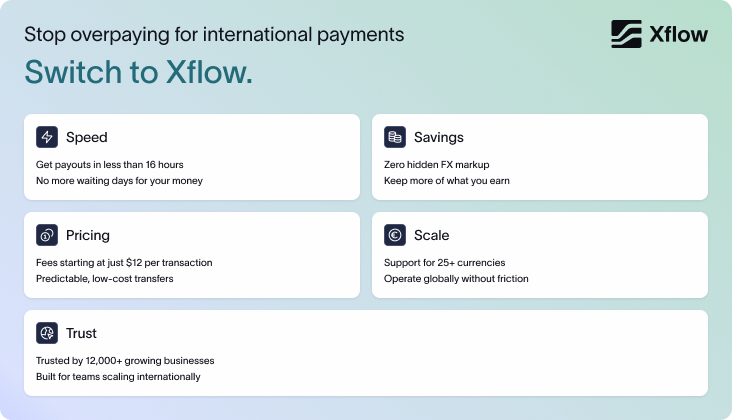
That’s the problem Xflow is built to solve. Instead of stitching everything together yourself, you get a setup where it’s already handled.
Check out our pricing to see what works for you.
Frequently asked questions
A compliant stablecoin is a digital currency that stays tied to something like the US dollar or euro, but follows proper rules. It works within a regulated system where things like identity checks and transaction monitoring are part of how it runs.
It comes down to how they’re handled. Regular stablecoins lean towards openness, while compliant ones are structured around compliance and visibility.
They’re expected to follow rules around reserves, user verification, and transaction tracking. On top of that, they need to stay transparent through regular updates and reports.
KYC means you need to verify who you are before using the service. AML means your transactions are monitored to catch anything unusual. Together, they help keep things safe.
Yes. Compliant stablecoins conduct user and transaction checks according to sanction lists to ensure that money is not sent to restricted individuals and jurisdictions.
Stablecoin issuers control the stablecoin at the issuance stage. They are supposed to maintain reserve management and redemptions as well as stay compliant and transparent.
Exchanges control users' interactions with the stablecoins. This includes user onboarding, transaction handling, and ensuring the whole process is compliant.
Generally speaking, yes. Since there is more security involved in the process, including checks, transparency, and clarity, they represent a safer choice.
There is greater uncertainty about their value and legal status, as well as a higher risk that they will be misused.
You should analyse the issuer of the stablecoin, the auditing of the reserves, and adherence to proper compliance procedures.
Yes, regular auditing and reporting provide insight into the management of reserve assets and increase transparency.
Yes, compliant stablecoins are frequently used in cross-border transactions, but regulations may vary across nations.
There are several technologies used, including Know Your Customer (KYC), transaction monitoring system, and fraud detection software.
Not yet. The compliance standards vary depending on the country, with most nations still working on creating their policies.
With increasing popularity, regulations become more organised, thus establishing compliance practices.