Key takeaways
- A merchant of record (MoR) is the legal seller of a product, responsible for the payment, tax, refunds and chargebacks.
- You can be your own MoR, or use a third-party MoR that resells your product to the customer.
- Third-party MoRs usually charge more than a payment gateway, in exchange for handling global sales tax and disputes.
- For Indian businesses, a foreign MoR becomes your customer: you invoice it, receive one payout and keep FEMA, eFIRA and GST records for that export.
- Many Indian exporters stay the seller and use an RBI-authorised cross-border payment aggregator instead.
What is a merchant of record?
A merchant of record (MoR) is the legal entity that sells a product to the customer and takes responsibility for the payment, the tax due on it, refunds and chargebacks. Its name appears on the buyer's card statement, and it can be your own business or a third-party company that resells your product.
Every online sale has a merchant of record, whether you notice it or not. If you sell through your own website with a payment gateway, your business is the MoR. If a third-party MoR sells on your behalf, it buys from you and resells to the customer, so the customer's contract is with the MoR.
What does MoR stand for?
The meaning of MoR in business and finance is merchant of record, so on a payment page, a SaaS pricing page or a card statement, that is what it refers to.
The same letters mean other things elsewhere: Ministry of Railways in Indian government, modulus of rupture in engineering, and middle-of-the-road in music and politics. If an unfamiliar company name appears on your card statement after an online purchase, it is usually the merchant of record that sold you the product.
How does a merchant of record work?
The merchant of record model works by standing between you and your customer: the customer buys from the MoR, which collects the money and tax and pays you the rest. It also handles any disputes before your payout.
- The customer checks out on a page run by, or connected to, the MoR.
- The MoR calculates the right sales tax, VAT or GST for the customer's location and charges it.
- The MoR processes the payment through its own merchant account and issues the invoice in its name.
- The MoR files and pays the tax to each country's tax authority.
- If the customer asks for a refund or raises a chargeback, the MoR handles it.
- At the end of the payout period, the MoR sends you the net amount with a statement.
Take a €49 monthly SaaS plan bought by a customer in Germany. The MoR charges €49 plus German VAT, keeps the VAT for the German tax office, deducts its fee, and adds the rest to your monthly payout alongside every other sale.
You never register for VAT in Germany, and the customer sees the MoR's name on the card statement. Refunds run the same way in reverse. For recurring billing, the MoR also stores the card or mandate and retries failed renewals.
What does a merchant of record do?
A merchant of record's responsibilities cover the legal and financial side of each sale: payment processing, tax calculation and filing, compliance, fraud checks, refunds and chargebacks. You still own the product, the customer experience and your pricing decisions, within the MoR's rules.
| Area | What the MoR does | What you still do |
|---|---|---|
| Payments | Runs the merchant account, accepts cards and local methods, converts currency | Choose which methods to switch on |
| Tax | Calculates, collects and files sales tax, VAT and GST in each country | Keep your own income tax and Indian GST records |
| Compliance | Meets PCI DSS, consumer law and data-protection duties for the sale | Follow its product and content rules |
| Fraud and disputes | Screens payments, fights chargebacks, issues refunds | Supply evidence of delivery when asked |
| Invoices and statements | Issues invoices in its name; its name shows on the statement | Brand the product and support users |
| Payouts | Pays you the net amount on a fixed schedule | Reconcile payouts with your books |
The right-hand column is the part most guides skip. An MoR removes the work of selling in 50 tax systems, but your business still has its own taxes, records and customer support to run.
When a chargeback arrives, for example, the MoR fights it, but it will ask you for login records or delivery proof. Keep those easy to find.
What are the types of merchant of record?
There are four types of merchant of record, and they differ in one thing above all: how much of the seller's legal and tax liability moves away from you, and what you pay for that.
Your own business as merchant of record
This is the default. You sell through your own website with a payment gateway, so your business is the legal seller. You register for tax where your sales require it, file returns, answer chargebacks and keep the customer relationship.
It is the cheapest route, usually a gateway fee of about 2% to 3% plus your own tax and admin costs. It suits B2B companies, service exporters and anyone selling in a few markets.
Third-party merchant of record service
A specialist company buys your software or digital product and resells it to each customer in its own name. It calculates and files sales tax or VAT in every country, handles refunds and disputes, and pays you a net amount on a schedule.
You pay more, often around 5% plus a fixed fee per sale, and give up some control of checkout and customer data. It suits SaaS, apps and digital downloads sold to consumers in many countries.
Marketplace or app store as merchant of record
When you sell through an app store or an online marketplace, the platform is the merchant of record. App stores are the merchant of record examples most people meet, every time they buy an app. It owns the checkout, collects the tax, deals with the buyer and pays you after its commission, which on major app stores is commonly 15% to 30%.
You get reach and almost no tax work, but the least control: the platform sets the rules, the payment flow and often the price formats.
Cross-border ecommerce merchant of record for physical goods
Some services act as merchant of record for physical products sold abroad. They price in local currency, collect duties and import tax at checkout, issue local invoices and manage returns, while you still ship the goods.
Fees are usually charged per order and vary by country and product. Check whether the service covers your product category and the countries you ship to, because coverage varies more than for digital goods.
Many businesses use more than one type. An Indian SaaS company might be its own merchant of record for business clients, use a third-party MoR for consumers in Europe, and sell its mobile app through app stores. To tell which type applies to a sale, look at whose name is on the customer's invoice.
What is the difference between a merchant of record, a PSP, a payment facilitator and a seller of record?
A merchant of record is the legal seller, while a payment service provider (PSP) or payment gateway only moves the money for you. A payment facilitator onboards many sellers under its account, and a seller of record owns the sale but not the payment flow.
| Role | Who is the legal seller? | Who handles sales tax? | Who absorbs chargebacks? | Name on the statement |
|---|---|---|---|---|
| Merchant of record (third party) | The MoR | The MoR | The MoR | The MoR |
| Payment service provider / gateway | You | You | You | Your business |
| Payment facilitator | You (as a sub-merchant) | You | You, via the facilitator | Your business or a combined name |
| Seller of record | The seller of record | The seller of record | Shared with the payment provider | Usually the seller of record |
A merchant of record costs more than a payment processor because it carries the tax and dispute liability that a processor leaves with you.
Choose a PSP or payment facilitator if you want to stay the seller and only need payments handled. Choose an MoR if you want to hand over the legal and tax side as well. A seller of record suits businesses that want to own the sale but keep payments with a separate provider.
For a full side-by-side, read our PSP vs MoR comparison, our guide to seller of record vs merchant of record and, if you are an Indian business choosing between an MoR and an RBI-authorised cross-border payment aggregator (PA-CB), our MoR vs PA-CB comparison.
Who needs a merchant of record?
A merchant of record suits businesses that sell digital products to consumers in many countries and do not want to register for tax in each one. It suits B2B companies, services firms and businesses selling mainly in one market far less.
- You sell software, apps, courses or digital downloads to consumers abroad
- Your buyers are spread across many countries with VAT or sales tax on digital sales
- Your team has no in-house international tax or payments staff
- You want to launch in new markets quickly without local entities
- Chargebacks and fraud take more time than you can spare
If three or more of these fit, an MoR is worth pricing. If you sell mainly to businesses, invoice by bank transfer, or sell in only a few countries, a payment gateway or a cross-border collection account usually costs less and keeps you in control.
A merchant of record for physical products is rarer, because customs, duties and returns add work that most MoRs avoid; the ones that handle physical goods tend to charge more and focus on cross-border ecommerce.
A Pune company selling a ₹1,500-a-year photo app to consumers in 40 countries is a classic MoR case. A Bengaluru agency billing five US clients $10,000 a month is not; it needs reliable cross-border collection, not a reseller.
What are the benefits and drawbacks of a merchant of record?
The main benefit of a merchant of record is that someone else carries global tax and dispute liability. The main drawback is cost, followed by less control over customer data, pricing and when you get paid.
| Factor | Benefit | Drawback |
|---|---|---|
| Tax | No sales tax or VAT registrations in each country; the MoR files and pays | You still handle your own income tax and home-country records |
| Disputes and fraud | Refunds, chargebacks and fraud checks are handled for you | You must still supply evidence when the MoR asks |
| Speed to market | Sell in dozens of countries from day one, without local entities | You can only sell where, and how, the MoR supports |
| Cost | No tax tools, registrations or payments staff to pay for | Higher fee per sale, plus currency and payout charges |
| Customer data and brand | Less personal data to protect yourself | The MoR owns checkout and its name is on the statement |
| Cash flow | One consolidated payout instead of many small receipts | Funds are held until the payout date, sometimes with a reserve |
| Switching | Easy to start, with little setup | Hard to leave: subscriptions and card details sit with the MoR |
Cost is the drawback to measure first. Published MoR rates often start around 5% plus $0.50 per transaction, compared with roughly 2.9% plus $0.30 for a card processor in the US before any tax tools.
On $100,000 a year in sales at an average order of $50, the MoR takes about $6,000 and the processor about $3,500. The processor route then needs tax software, registrations and staff time, so for a small team the $2,500 gap can still be the cheaper option.
The benefits usually outweigh the drawbacks when you sell digital products to consumers in many countries and have no tax team. They usually do not when you sell to businesses, invoice large amounts or need full control of pricing and customer data.
Are Stripe, Shopify and PayPal merchants of record?
Not by default. Stripe, Shopify Payments and PayPal process payments while your business stays the merchant of record. Stripe and Shopify each offer a separate product where a merchant of record steps in.
Is Stripe a merchant of record?
No, not for standard Stripe payments: you are the seller and handle your own sales tax. Stripe's separate Managed Payments product does act as a merchant of record for the transactions you choose to run through it, taking on sales tax, fraud and disputes. You can use it for some markets or products and keep standard payments elsewhere. On standard payments, a tax tool can calculate the tax at checkout, but the registrations, filings and liability stay with you.
Is Shopify a merchant of record?
No, not by default. On Shopify Payments and Shopify Markets you remain the merchant of record. If you switch on Shopify Managed Markets, its partner Global-e becomes the merchant of record for those international orders and handles duties and tax remittance for a per-order fee. Domestic orders stay with you. Managed Markets is only available to stores in certain countries, so check Shopify's eligibility list before you plan around it.
Is PayPal a merchant of record?
No. PayPal checkout moves the money and offers buyer protection, but your business is still the seller, and the tax duty stays with you. Marketplaces that use PayPal behind the scenes are a different case, because there the marketplace itself is the merchant of record for the sale.
Before adding new countries, check what your current processor actually covers. Assuming it acts as merchant of record can leave you without tax registrations it never handled for you.
How do you choose a merchant of record provider?
Compare merchant of record providers on total cost, payout terms, country and product coverage, data access and exit terms, then checking how its payouts fit your own tax and export records.
| What to compare | Question to ask the provider |
|---|---|
| Total cost | What is the all-in rate per transaction, including currency conversion and payout fees? |
| Payouts | How often do you pay out, in which currencies, and how long is the reserve? |
| Coverage | Which countries, tax regimes and payment methods do you support? |
| Products | Do you support physical goods, services or only digital products? |
| Customer data | Do I get full access to customer emails, subscriptions and payment data? |
| Exit | How do I migrate subscriptions and card tokens if I leave? |
| Records | Will your payout statements and invoices support my export and tax filings at home? |
Which merchant of record provider is best for SaaS? The one that clears all seven rows for your model, not the one with the lowest headline rate. A cheap rate with monthly payouts and no data export can cost more than a pricier provider with weekly payouts.
For Indian companies, the last row decides a lot. Ask for a sample payout statement and show it to your chartered accountant before you sign.
How do you become a merchant of record?
To become a merchant of record, you set up your own merchant account, payment processing and tax registrations, and take on the compliance, refund and chargeback duties yourself. Most businesses selling on their own site with a gateway already are one.
- Open a merchant account through a payment gateway or acquirer.
- Register for tax wherever your sales create an obligation, such as EU VAT on digital services.
- Set up tax calculation at checkout and a filing calendar for each registration.
- Meet PCI DSS for card data, usually by using a gateway's hosted checkout.
- Publish refund, cancellation and dispute policies, and a process to answer chargebacks.
- Add fraud screening suited to your products and markets.
For a business selling in a handful of countries, this is manageable with a gateway, a tax tool and an accountant. The burden grows with every new consumer tax regime, which is when outsourcing to a third-party MoR starts to pay for itself.
For Indian exporters selling from their own site, that already includes GST export and FEMA duties. Platforms that want to act as MoR for other sellers face more: seller checks, rules for paying out other people's money and, in India, RBI authorisation for payment aggregation.
Can an Indian business use a merchant of record?
Yes. No Indian law stops an Indian business from selling through a foreign merchant of record, but the MoR becomes your customer, so you must treat the arrangement as an export to the MoR and keep FEMA, invoice, eFIRA and GST records to match.
| Your situation | Usually fits better | Why |
|---|---|---|
| Consumer app or digital product sold in many countries | Third-party MoR | It absorbs VAT and sales tax in each country |
| B2B SaaS billed to companies abroad | Stay the seller; cross-border payment aggregator | Business buyers handle their own tax; you keep data and control |
| Services or agency work for foreign clients | Stay the seller; receive by bank transfer | Simple invoices and direct eFIRA per payment |
| Mix of Indian and US users (for example 50/50) | Stay the seller for both, or MoR only for overseas consumers | Indian sales need UPI and GST anyway |
| Physical goods shipped abroad | Stay the seller | Most MoRs focus on digital products; customs stays with you |
The table is a starting point, not tax advice. Run your own numbers and paperwork past a chartered accountant before you sign with an MoR.
What changes for FEMA, eFIRA and GST?
With a foreign MoR, you sell to the MoR and the MoR sells to the end customer, so your export is the supply to the MoR. Each area of compliance follows from that.
| Area | What changes with a foreign MoR | What to do |
|---|---|---|
| Invoices | Your customer is the MoR, not each buyer | Invoice the MoR, usually once per payout period, matching its payout statement |
| FEMA | Proceeds still count as export proceeds | Make sure proceeds are realised within nine months of each invoice date (rule from 1 October 2026), so check the MoR's payout cycle |
| FIRC or eFIRA | Each payout arrives as one foreign inward remittance | Get a FIRC or eFIRA per payout and match it to the invoice you raised |
| GST | The supply to the MoR can still be an export of services | It can be zero-rated under a Letter of Undertaking if the MoR and place of supply are outside India and you are paid in foreign currency |
| Records | You see the MoR, not each end customer | Keep the MoR's payout statements as your per-sale detail |
Most of the 'FIRC gap' warnings online come from treating MoR payouts as if they were customer payments. Invoicing the MoR correctly removes that mismatch. For the documents themselves, see our guides to export of services under GST and FIRC vs FIRA.
What if a foreign company sells into India through an MoR?
A foreign company can sell into India through a merchant of record, and the MoR then carries India's rules for the sale. Online services sold to Indian consumers attract 18% IGST, and a foreign supplier must register under GST from the first sale. Recurring card and UPI payments follow RBI's e-mandate rules, with extra authentication above ₹15,000 per charge, or ₹1 lakh for insurance, mutual funds and credit card bills.
What is the alternative to a merchant of record for Indian exporters?
The main alternative for Indian exporters is to stay the merchant of record and collect through an RBI-authorised cross-border payment aggregator. You remain the seller and get a document for every payment.
This suits B2B SaaS, agencies and service exporters best. Your client pays you, your invoice names the client, and each receipt comes with its own record for FEMA and GST, so reconciliation stays one-to-one with your invoices.
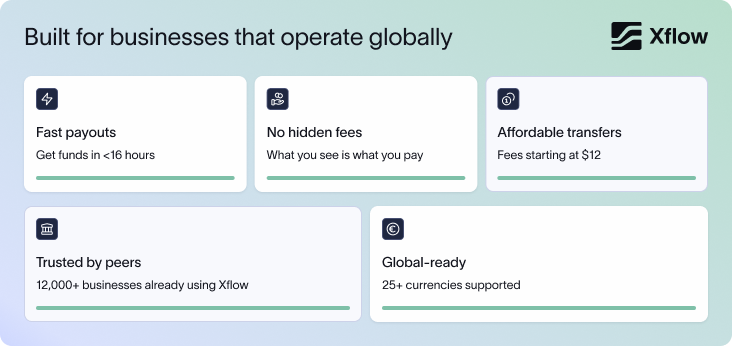
Xflow is built for this route. It holds RBI authorisation as a cross-border payment aggregator for inward and outward payments. With receiving accounts, you collect in 25+ currencies, with pricing linked directly to the live mid-market rate, settlement to your Indian bank account the next business day, and an eFIRA within 24 hours for every international transaction.
Xflow is not a merchant of record; you remain the seller and handle your own sales tax abroad where it applies. For consumer digital sales into many VAT countries, a third-party MoR may still be simpler, and some businesses use both: an MoR for consumer sales and direct collection for business clients.
Whichever route you take, ask two questions first: is the provider RBI-authorised as a cross-border payment aggregator, and does it give you a record for every payment? The answers show quickly whether it fits Indian export rules.
Ready to get started?
Frequently asked questions
It means your business name is on the customer's invoice and you carry the payment, tax and dispute liability for that sale.
The business legally selling to the customer, responsible for the payment, tax, refunds and chargebacks.
Merchant of record, in payments. It can also mean Ministry of Railways or modulus of rupture in other fields.
No. A gateway moves the money; a merchant of record is the legal seller and carries tax and dispute liability.
Not for standard payments; you are the seller. Stripe's separate Managed Payments product acts as one.
Not by default. With Shopify Managed Markets, its partner Global-e becomes the MoR for international orders.
Published rates often start around 5% plus $0.50 per transaction, with currency and payout fees on top.
Yes. Indian businesses can sell through a foreign MoR, treating it as an export to the MoR with matching FEMA, eFIRA and GST records.
Yes. If you sell through your own site with a payment gateway, you already are.
No. Xflow is an RBI-authorised cross-border payment aggregator; you stay the seller and receive payments with an eFIRA for each one.