Introduction
Businesses engage with many other businesses, be it for procuring source material for production or selling their product and services to them. It doesn’t just involve sending and receiving payments, but also requires sharing purchase orders, invoices and shipping details. If you want to scale your business, you cannot continue relying on paper-based transmission, which is not only slow but also prone to security threats.
So, how do you make this process efficient? By using EDI payments. With this article, we explore what EDI payment is and how it is used in business transactions
What is an EDI payment?
EDI payments, or Electronic Data Interchange Payments, are a method businesses use to exchange payment-related information in a standardised format directly within their ERP systems. It uses transmission protocols like AS2 or OFTP, which ensure your data is securely transmitted to your trading partner in a time-efficient manner.
EDI payments are not a payment method, but rather a transmission channel for sharing details accompanying it, such as a purchase order, invoice, bank account information, etc. It replaces traditional methods, such as fax or physical mail, which were time-consuming, prone to error and susceptible to security breaches.
What are the types of EDI payments?
The type of EDI payment system you use will depend on the scale and integration requirements of your business. Here are some common EDI payment systems for consideration.
1. Direct or Point-to-point EDI
Direct or point-to-point EDI consists of a single pathway between two businesses' internal systems. It is used by businesses that process a large volume of transactions with only a few trading partners. A major requirement of point-to-point EDI is that businesses must use the same protocol and format for transferring data.
2. Web EDI
As the name suggests, web EDI allows businesses to transfer files using a web browser through third-party tools or a hosted web tool, but with limited resources. It is mostly used by SMBs that require an EDI payment system without investing in complex infrastructure.
3. Value-Added Network EDI
Value-Added Network EDI is facilitated by a private network that is integrated into your business system. VAN EDI supports multiple formats and protocols for transferring payment information across businesses. It is often used by large businesses that engage with multiple partners.
What are EDI payment file formats?
Since EDI payment files pass between the computer systems of businesses, their file formats also have to be computer-readable. Some of the common formats for EDI payments are
1. UN/EDIFACT
UN/EDIFACT stands for United Nations rules for Electronic Data Interchange for Administration, Commerce and Trade. It is globally adopted and used across many industries in international trade. EDIFACT files are recognised by a six-letter code, which is followed by a structured sequence of EDI segments such as UNB, UNH, UNT, etc.
2. ANSI ASC X12
ANSI ASC X12 stands for American National Standards Institute Accredited Standard Committee X12. It is primarily used across North America. ANSI ASC X12 has over 300 standards, identified by a three-digit number, such as 850 for a purchase order.
3. TRADCOMS
TRADCOMS is primarily used in the UK’s retail industry. It consists of a hierarchy of 26 messages, each identified by a six-letter reference.
4. UBL
UBL or Universal Business Language is an XML-based standard which is easier to read compared to other formats, but it also makes them heavier. It was developed by the Organisation for the Advancement of Structured Information Standards (OASIS).
Save More on International Transfers
How does EDI payment work in Business Transactions?
1. Data preparation
EDI payments start extracting information that needs to be transmitted to your trading partner. It can be an invoice or a purchase order.
2. EDI format conversion
Your EDI system converts this information into a standard EDI format agreed upon by both trading partners. This format can be ANSI X12, XML, EDIFACT, etc.
3. Transmission
This EDI file is then sent to the recipient via transmission protocols such as Value-Added Network (VAN), AS2 or OFTP, which ensure the encryption and security of your data.
4. Receipt and acknowledgement
The file is received by your business partner’s EDI system, which sends back an acknowledgement message. The EDI system converts this file into a format understood by the internal system and updates it.
How does EDI payment benefit businesses?
As your business scales, you cannot keep relying on outdated, time-consuming methods for exchanging payment information. By incorporating EDI payment in your business, you can reap the following benefits.
1. Save time
EDI payment automates the transmission, receipt, and processing of data. It exchanges it in real time with your business partners, helping you save time by eliminating manual tasks.
2. Reduce errors
Manually entering data and transferring it across systems is prone to human error. EDI payments automatically structure payment information in the desired format and also update the internal system on receiving data from other businesses, significantly reducing errors.
3. Enhance security
EDI payment transfer data is transmitted via protocols that encrypt it and add authentication measures. This confidentiality and security are not possible in paper-based methods of transmitting data.
4. Increased efficiency
With automated data transmission and receipt and reduced errors, you can focus on other important business operations that increase productivity and profitability.
5. Reduce costs
EDI payments use electronic channels to transmit information and eliminate manual data entry. This helps save on the costs associated with buying paper, postage and labour.
Conclusion
EDI payments enable businesses to transmit their payment data, such as invoices and purchase orders, via secure, high-speed channels. By eliminating paper-based methods of sharing data, it helps your business save time and cost, increase efficiency, reduce errors and enhance security. But it should be accompanied by an equally fast and secure payment solution.
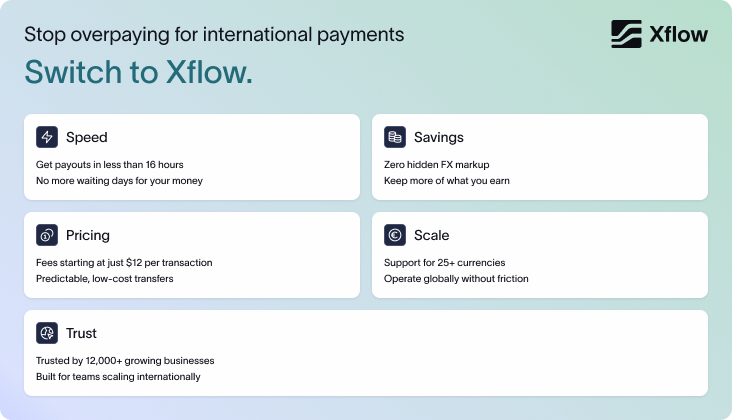
XFlow would be this payment solution for you. It enables businesses to receive instant international payments and settle them in their bank account within 24 hours. With Xflow, you get mid-market FX rates and no hidden fees.
Save More on International Transfers
Frequently asked questions
EDI payment type depends on the scale and integration requirements of your business and is of three types. There are Direct (point-to-point) EDI, Web EDI and Value-Added Network EDI.
Some of the common formats of EDI are TRADCOMS, UN/EDIFACT, ANSI ASC X12 and UBL.
EDI stands for Electronic Data Interchange and is used solely to transmit information related to payments, while EFT stands for Electronic Fund Transfer, which refers to transferring money via ACH, wire transfers or digital wallets.